

Edge computing servers fit low-latency application design by processing data close to the source, which drastically reduces response times and minimizes data travel to centralized data centers. This proximity enables real-time responses critical for applications like autonomous vehicles and augmented reality. By localizing data processing, you improve user experience, decrease network congestion, and guarantee continued service during disruptions. If you want to understand how this setup maximizes performance, keep exploring these key concepts.

Get business pricing on networking and server gear
- Business-only prices and quantity discounts
- Tax-exempt purchasing
- Multiple users, one account, clear invoices
Key Takeaways
- Edge computing servers process data locally, significantly reducing latency for real-time application responses.
- Proximity to data sources enables instant decision-making critical for low-latency applications.
- Local data processing minimizes transmission delays, ensuring faster response times.
- Distributed edge nodes enhance resilience and maintain service continuity during network disruptions.
- Reduced bandwidth needs from local processing optimize network traffic and support scalable, low-latency solutions.
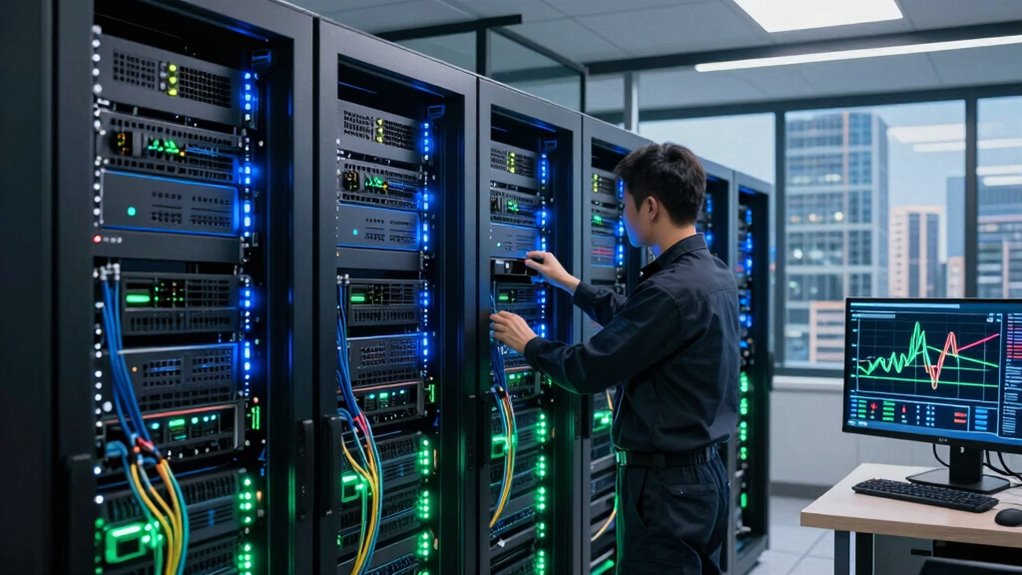
Edge computing servers are transforming how low-latency applications operate by bringing data processing closer to the source. This shift means you can process data locally, reducing the time it takes for information to travel back and forth to centralized data centers. When speed is critical—such as in autonomous vehicles, real-time analytics, or augmented reality—this proximity is a game-changer. It allows you to deliver instant responses and a seamless user experience. But beyond speed, edge servers also help safeguard data privacy by keeping sensitive information closer to its origin, minimizing exposure during transmission. This local processing guarantees that personal or confidential data doesn’t need to traverse long networks, reducing the risk of breaches and complying with stricter data privacy regulations. Additionally, implementing network security strategies at the edge can further enhance data protection and mitigate potential threats. Server scalability is another key advantage of deploying edge computing for low-latency applications. Traditional cloud architectures often struggle with scalability during sudden spikes in demand, leading to delays and potential outages. Edge servers, however, can be scaled more flexibly across multiple locations, giving you the ability to expand capacity incrementally and precisely where it’s needed most. This distributed approach ensures that your system remains responsive, even during peak loads or network disruptions. You can add or upgrade servers at the edge without overhauling your entire infrastructure, making it easier to adapt to evolving application requirements and user demands. Furthermore, edge servers support the design of resilient applications by decentralizing data processing. Instead of relying solely on a single centralized data center, you distribute workloads across multiple edge nodes. This architecture minimizes the impact of network failures or server outages, maintaining application availability and performance. It also reduces network congestion because data is processed locally, freeing up bandwidth for other critical tasks. Incorporating edge computing into your low-latency application design also means you can optimize resource utilization. By processing data at the point of collection, you eliminate unnecessary data transmission, lowering operational costs. Plus, with scalable edge infrastructure, you can dynamically allocate resources based on current needs, ensuring your applications run efficiently without overspending on unused capacity. Moreover, understanding the impact on network traffic is essential when designing such systems, as local processing shifts the data flow and can significantly reduce bandwidth requirements. Recognizing how distributed processing enhances system resilience is also crucial in maintaining continuous service during disruptions, especially as more applications become reliant on edge infrastructure for seamless operation.
edge computing servers for low latency
As an affiliate, we earn on qualifying purchases.
As an affiliate, we earn on qualifying purchases.
Frequently Asked Questions
How Does Edge Computing Impact Data Privacy and Security?
Edge computing enhances data privacy and security by enabling you to process data locally, reducing exposure. You can implement data encryption at the edge, guaranteeing sensitive information stays protected during transmission and storage. Access control plays a vital role, allowing you to restrict who can access specific data or systems. Together, these measures help you maintain better security, minimize risks, and confirm compliance with privacy regulations in your low-latency applications.
What Are the Main Challenges in Deploying Edge Servers?
When deploying edge servers, you face challenges like guaranteeing seamless edge server deployment across diverse locations and managing hardware optimization to handle fluctuating workloads efficiently. You must also address network reliability issues, security risks, and maintaining up-to-date hardware. Overcoming these hurdles requires careful planning, robust infrastructure, and ongoing maintenance to ensure low-latency performance and reliable service delivery at the network’s edge.
How Do Edge Servers Compare Cost-Wise to Centralized Data Centers?
You’ll find that edge servers can be more cost-efficient than centralized data centers for low-latency applications, especially when considering reduced data transmission costs and faster processing. They offer greater infrastructure flexibility, allowing you to deploy resources closer to users and adapt quickly to changing demands. While initial setup might be higher, the long-term savings and improved performance often make edge servers a smarter investment for low-latency needs.
What Hardware Specifications Are Essential for Edge Servers?
Think of edge servers as the Swiss Army knives of hardware—they need to be versatile and efficient. You’ll want robust CPUs, ample RAM, and fast SSDs to guarantee hardware optimization. Performance tuning is essential, so prioritize low-latency network interfaces and reliable power supplies. These specs enable your edge servers to process data quickly and handle high-demand applications, keeping latency minimal and performance maximum.
How Scalable Are Edge Computing Solutions for Growing Applications?
Edge computing solutions are quite scalable for growing applications, especially if you design with edge scalability in mind. You can add more edge nodes or upgrade existing hardware to handle increased data and processing needs. This flexible approach allows your application to expand seamlessly, reducing latency and maintaining performance as your user base or data volume grows. Proper planning guarantees your edge infrastructure adapts efficiently to support ongoing application growth.
industrial edge servers for real-time processing
As an affiliate, we earn on qualifying purchases.
As an affiliate, we earn on qualifying purchases.
Conclusion
By integrating edge computing servers into your low-latency applications, you’re bringing data closer to your users, ensuring faster responses and smoother experiences. Remember, “A chain is only as strong as its weakest link.” Don’t overlook the importance of strategic placement to maximize efficiency. Embrace the edge, and you’ll stay ahead of the curve, delivering the real-time performance your users demand. The future belongs to those who adapt quickly and think locally.
autonomous vehicle edge computing hardware
As an affiliate, we earn on qualifying purchases.
As an affiliate, we earn on qualifying purchases.
As an affiliate, we earn on qualifying purchases.
Fall Picks
fall essentials
As an affiliate, we earn on qualifying purchases.