Choosing between ARM and x86 for your VPS depends on your workload needs and budget. ARM offers better energy efficiency, cost savings, and is ideal for scalable, less demanding tasks, especially in cloud and edge environments. x86 provides higher performance for demanding, legacy, or compute-bound applications. To find the best match for your use case and explore the latest industry insights, keep exploring your options.
Key Takeaways
- ARM offers better energy efficiency and lower costs, ideal for scalable, cost-effective VPS hosting.
- x86 provides higher performance for demanding, legacy, or compute-intensive applications.
- Compatibility and software ecosystem support are stronger with x86, impacting application deployment.
- ARM is increasingly supported in cloud environments, making it suitable for modern, AI-driven workloads.
- Choice depends on workload requirements, energy efficiency needs, budget constraints, and software compatibility.
Understanding the Core Differences Between ARM and X86
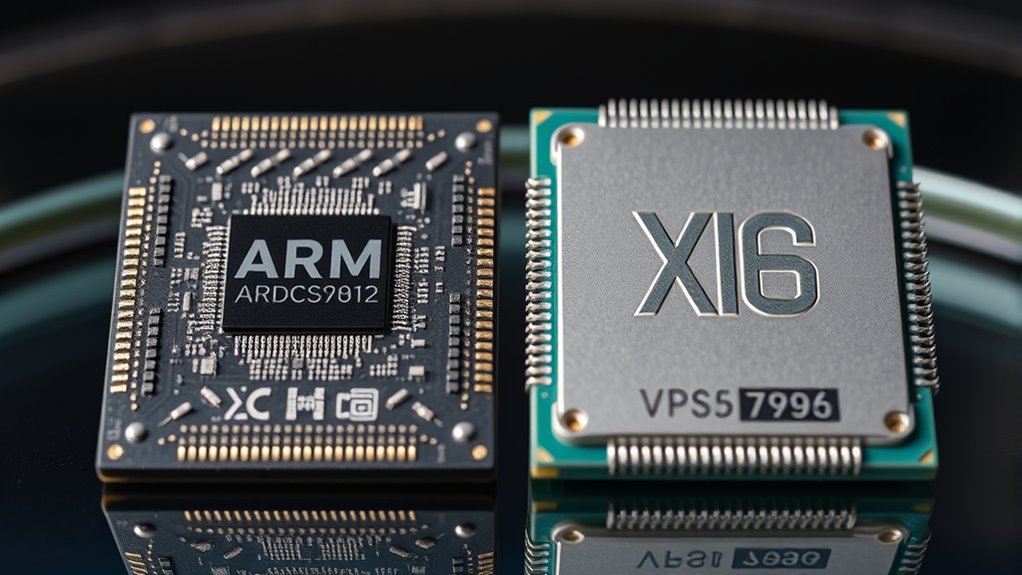
To understand the core differences between ARM and x86 architectures, it’s important to recognize that they are built on fundamentally different design philosophies. ARM uses RISC architecture, prioritizing simplicity and efficiency with fewer instructions that execute quickly and consume less power. In contrast, x86 employs CISC architecture, offering a complex instruction set that handles demanding tasks but requires more power. ARM’s design emphasizes energy efficiency and is often integrated into mobile devices and IoT, while x86 focuses on high performance and flexibility for desktops and servers. Additionally, ARM licenses its designs to various manufacturers, creating diverse implementations, whereas x86 processors are mainly produced by Intel and AMD. ARM frequently combines multiple components into a system-on-a-chip, unlike x86, which often separates CPU and other parts. The choice between these architectures can significantly influence system compatibility and software development strategies. Moreover, the widespread adoption of ARM in emerging fields like cloud computing and edge devices continues to expand its relevance in the technology landscape, driven by its adaptable design and energy-efficient performance. As the demand for power efficiency grows, ARM’s presence in high-performance data centers is also increasing, challenging traditional x86 dominance.
Performance and Power Efficiency in VPS Deployment

When evaluating VPS options, performance and power efficiency become key considerations, especially with ARM and x86 architectures offering different strengths. ARM processors handle multithreaded workloads effectively, making them suitable for sustained tasks, while x86 excels at single-threaded, compute-bound applications. Benchmark results show a small performance gap, with ARM trailing by about 7%, but it remains capable in request throughput. Power consumption is a major advantage for ARM, typically around 180 watts compared to 205 watts for x86, leading to lower cooling needs and reduced operational costs. ARM’s energy efficiency benefits data centers and cloud services, lowering ecological impact. Additionally, ARM’s lower production costs and instance pricing provide up to 50% better cost efficiency, making it an attractive choice for budget-conscious deployments focused on long-term savings. Historically, ARM’s design principles have emphasized power efficiency, which continues to influence its growing presence in data center hardware. The trend toward energy-efficient architectures further supports ARM’s increasing adoption across various industries. Moreover, advancements in hardware integration are enhancing ARM’s capabilities for diverse computational tasks.
Compatibility and Software Ecosystem Considerations
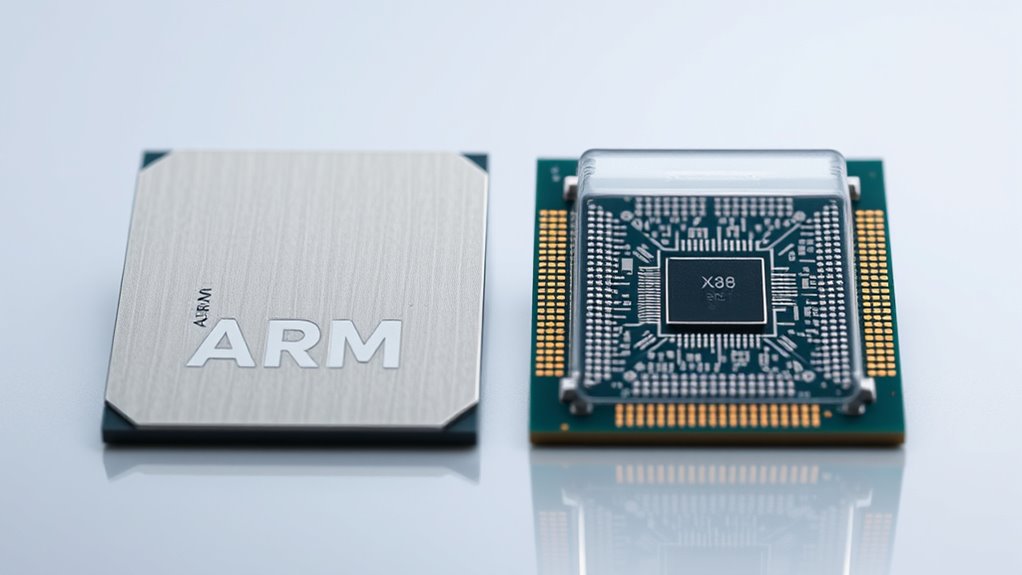
While ARM processors are gaining ground, compatibility and ecosystem support remain significant considerations. Operating systems like Windows, many Linux distros, and macOS Intel don’t run natively on ARM without modification or emulation, which can impact performance and stability. ARM supports mobile OSes such as Android and iOS, with increasing support for Linux and Windows on ARM variants. Virtualization layers and emulators enable running x86 applications on ARM, but with some performance and compatibility trade-offs. Software optimized for x86, especially legacy enterprise applications, often lacks ARM versions, limiting deployment options. Development tools and libraries are predominantly tailored to x86, making ARM development more complex. Cloud environments favor x86 for broad compatibility, though ARM support is expanding, meaning you must weigh ecosystem maturity against your specific workload needs. Additionally, Self Watering Plant Pots demonstrate how integrated systems can effectively manage resources, a concept applicable when considering the integration of hardware and software in CPU architectures. As the ecosystem around ARM continues to mature, the gap in software support for enterprise and specialized applications is gradually narrowing. Moreover, energetic alignment principles from the Law of Attraction highlight the importance of fostering positive energy around technological choices, which can influence future development and adoption trends.
Cost, Scalability, and Cloud Integration Factors

ARM and x86 architectures differ markedly in cost, scalability, and cloud integration. ARM VPS plans are generally more affordable, saving you about 20-40% compared to x86 options, thanks to simpler, cheaper chips and lower energy costs. x86 processors, like Intel Xeon and AMD EPYC, have higher initial costs but often deliver peak performance for demanding workloads. When it comes to scalability, ARM’s performance per watt allows for cost-effective scaling with numerous modest cores, while x86 excels at high-performance, bursty tasks. This scalability is further supported by the expanding ecosystem and cloud support for ARM, with providers like AWS and Ampere offering optimized solutions. You benefit from:
- Lower operational costs with ARM’s energy efficiency
- Competitive pricing for steady workloads
- Ecosystem support for hybrid cloud setups
- Mature management tools across architectures
- Growing adoption demonstrates the increasing importance of architecture choices in cloud infrastructure. Additionally, software compatibility continues to improve as more applications are optimized for ARM, making it a more versatile choice for diverse workloads.
Suitability for Industrial and Edge Computing Applications

Choosing between x86 and ARM for industrial and edge computing depends on your specific performance, power, and environmental requirements. x86 architectures excel in centralized control systems, SCADA, and high-performance AI tasks that need robust processing power. They handle complex operations efficiently and support legacy industrial software. Additionally, the compatibility of hardware components with existing systems can influence long-term integration and maintenance costs. In contrast, ARM’s architecture benefits from significant energy efficiency, making it ideal for distributed edge nodes and IoT devices, especially in harsh environments. Its compact design enables fanless, rugged deployments. The thermal management capabilities of hardware components are also crucial in industrial environments to ensure reliable operation. Consider the table below:
| Feature | x86 | ARM |
|---|---|---|
| Performance | High for compute-intensive | Optimized for efficiency |
| Power | Higher consumption | Lower, suitable for remote |
| Compatibility | Extensive legacy support | Growing but limited native software |
| Deployment | Centralized, high-power environments | Distributed, energy-constrained settings |
Additionally, the noise levels of hardware components can be a crucial factor in industrial settings, especially where noise pollution needs to be minimized.
Future Trends and Strategic Implications for VPS Providers

The evolving market dynamics are pushing VPS providers to rethink their architecture strategies as demand for scalable, cost-efficient solutions increases. With Arm aiming to grow its data center CPU market share from 15% to 50% by 2025, providers must consider the rising adoption of Arm-based chips driven by AI and cloud services. While x86 CPUs still dominate, emerging competitors and cloud giants like AWS using Arm-based Graviton CPUs highlight a shift toward cost and performance benefits. Resistance from enterprises over legacy software and ecosystem maturity remains a barrier. To stay competitive, providers are increasingly adopting heterogeneous infrastructures that combine Arm and x86. This approach helps balance performance, compatibility, and cost while preparing for a future where:
- Software ecosystem expansion accelerates.
- Cost and energy efficiency become primary drivers.
- AI workloads favor Arm’s architecture.
- Ecosystem maturity influences strategic choice.
Furthermore, the development of specialized hardware for vape juice storage and management illustrates how emerging technologies can influence infrastructure decisions.]
Frequently Asked Questions
How Does Hardware Security Differ Between ARM and X86 CPUS?
You’ll find that hardware security differs mainly in design and features. ARM integrates CPU and peripherals on a single chip, reducing attack surfaces, and uses TrustZone for secure environments. x86 processors from Intel and AMD often have advanced features like SGX and SEV, offering robust enclave protections. While ARM’s security varies with different implementations, x86’s standardized features tend to provide more consistent hardware security, making it easier to assess and trust.
Can Existing VPS Software Seamlessly Transition From X86 to ARM?
You might think existing VPS software can seamlessly shift from x86 to ARM, but that’s often not the case. Many applications depend on x86-specific code, assembly, or proprietary libraries, requiring refactoring or emulation to run on ARM. While modern Linux distributions and open-source projects support ARM well, legacy or proprietary software may need significant adjustments, making a completely seamless switch unlikely without careful planning and testing.
What Are the Environmental Impacts of Adopting Arm-Based Servers?
Adopting arm-based servers significantly reduces your environmental impact. They consume up to 37% less power, lowering greenhouse gas emissions and cooling requirements. Using less energy means your data center’s carbon footprint shrinks, supporting sustainability goals. Furthermore, many cloud providers now offer Arm instances, making it easier for you to scale efficiently. By switching, you’re helping to cut global energy consumption and promote a greener, more sustainable future for your infrastructure.
How Do Licensing Costs Compare for ARM Versus X86 Infrastructure?
You might think licensing costs are similar for ARM and x86, but actually, ARM’s licensing model tends to be more flexible and often more affordable. ARM companies pay for the right to design processors, which can cut costs, especially at scale. In contrast, x86 involves higher licensing fees due to its complex architecture and dominance by Intel and AMD. So, if cost is your main concern, ARM usually offers a more budget-friendly option.
Are There Performance Differences in Virtualization Capabilities Between the Architectures?
You’ll notice ARM delivers 15–20% better performance on CPU-intensive math and data workloads, while also offering around 10% gains in memory-heavy tasks. However, x86 generally outperforms in broader benchmarks and supports legacy applications with advanced extensions like AVX and SSE. ARM’s virtualization is efficient and cost-effective, especially for modern, cloud-native workloads, but x86 remains stronger for high-performance, single-threaded, and legacy-dependent tasks.
Conclusion
Choosing between ARM and x86 for your VPS depends on your needs. ARM offers impressive power efficiency, saving up to 30% on energy costs, making it ideal for scalable, eco-friendly setups. Meanwhile, x86’s broad compatibility supports a vast software ecosystem. As the market shifts, understanding these differences helps you make smarter decisions. Remember, over 80% of cloud workloads still run on x86, but ARM’s growth is accelerating rapidly—shaping the future of VPS technology.