
Choosing between IPv6-only and dual-stack VPS depends on your needs. IPv6-only offers a vast address space, lower costs, and simplified management, but can face compatibility issues with IPv4 services. Dual-stack ensures broad compatibility and smoother migration, yet adds complexity and higher costs. Understanding these trade-offs can guide your transition strategy. Keep exploring to discover the best approach tailored to your network goals.
Key Takeaways
- IPv6-only VPS offers scalability and security benefits but faces compatibility issues with IPv4-only services.
- Dual-stack VPS ensures broad compatibility but increases operational complexity and costs.
- Transition strategies typically favor dual-stack for gradual migration, leveraging its seamless compatibility.
- IPv6 market growth underscores the importance of planning for IPv6 adoption and transition methods.
- Choosing between IPv6-only and dual-stack depends on current infrastructure, service needs, and future scalability goals.
Comparing the Advantages and Disadvantages of IPv6-Only and Dual-Stack VPS
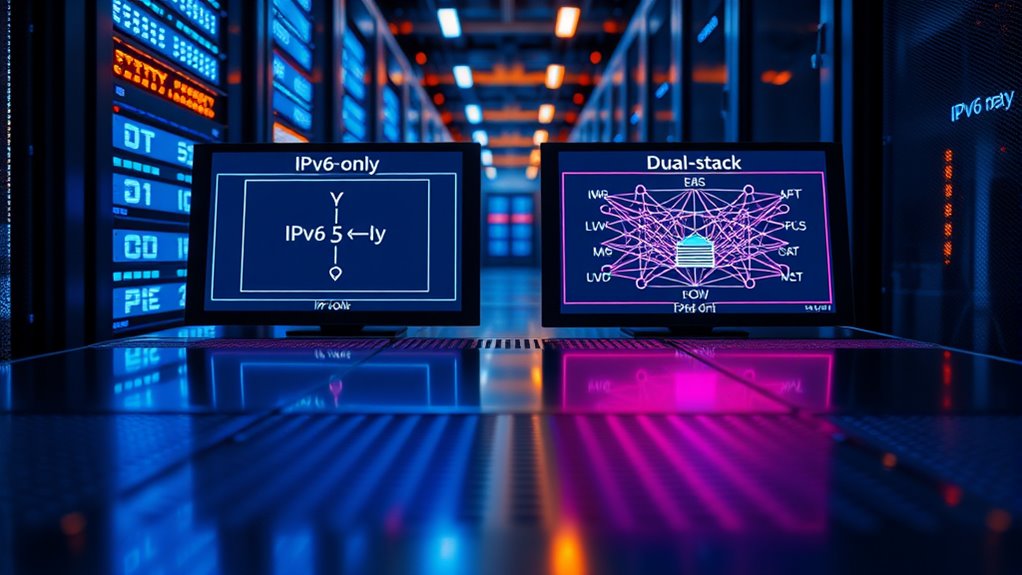
When comparing IPv6-only and dual-stack VPS, it’s important to contemplate how each approach impacts scalability and compatibility. IPv6 offers a virtually unlimited address space, making it ideal for growth, while IPv4’s limited addresses cause shortages and higher costs. Dual-stack supports both protocols, ensuring broad compatibility with legacy IPv4 systems and smoother migration, without service interruptions. IPv6 eliminates NAT overhead, improving latency and throughput, and includes native IPsec for security. Additionally, network management becomes more streamlined with dual-stack since most systems support both protocols, but it adds operational complexity. IPv6-only setups may face challenges interacting with IPv4-only services unless translation technologies are employed, adding complexity. Translation technologies can help mitigate these issues but also introduce additional management considerations. Dual-stack simplifies management since most systems support both protocols, but it increases operational complexity. IPv6-only solutions are often cheaper but may limit reach for certain services, while dual-stack offers extensive connectivity at the cost of increased management effort.
Effective Approaches to Transitioning From IPV4 to IPV6 or Dual-Stack Configurations

Moving from IPv4 to IPv6 or dual-stack setups requires careful planning to guarantee a smooth upgrade. First, assess your network and application readiness by inventorying devices, applications, and services to identify IPv6 support gaps. Compatibility testing for DNS, firewalls, and management tools reduces operational risks. For a phased transition, dual-stack is the most common approach, allowing simultaneous IPv4 and IPv6 operation:
| Step | Focus Area | Action |
|---|---|---|
| 1 | Network Devices | Upgrade hardware supporting IPv6 |
| 2 | Applications | Revise or replace legacy apps lacking IPv6 |
| 3 | Testing | Conduct thorough compatibility tests |
| 4 | Deployment | Implement phased rollout with pilot testing |
This strategy minimizes disruptions and facilitates a seamless transition. Additionally, understanding Gold IRA options can be beneficial for diversifying long-term investments during such infrastructure upgrades. Moreover, applying network compatibility best practices ensures a smoother and more reliable migration process. Incorporating mindfulness techniques during the planning phase can help teams stay focused and reduce stress throughout the transition process. Engaging in emotional support strategies can also be valuable for team members navigating change and uncertainty during the upgrade.
Current Trends and Market Insights in IPv6 Deployment and Hosting Strategies
The global IPv6 deployment landscape is rapidly evolving, driven by surging demand from emerging markets, cloud computing, and IoT expansion. You’ll notice that:
- Market size surpassing USD 6.22 billion in 2025 and projected to reach USD 89.79 billion by 2035 shows explosive growth.
- IPv6-enabled devices will grow from 41.4 billion in 2024 to 127.6 billion by 2030, highlighting increasing connectivity.
- North America leads with over 42% market share, but Asia Pacific is fastest-growing, driven by countries like China and India.
- Adoption rates hover around 43%, with regions like France and Germany surpassing 75%, influenced by policy and infrastructure maturity.
- The adoption of AI-driven tools in network management can help optimize IPv6 deployment strategies, making automation a key component in modern transition plans. Additionally, market insights reveal that organizations are increasingly prioritizing IPv6 readiness to stay competitive.
- As IPv6 adoption accelerates, understanding transition strategies becomes essential for organizations aiming for seamless migration without service disruption. Analyzing cost implications is also crucial for planning successful upgrades.
These trends indicate a shifting focus toward IPv6, though dual-stack remains prevalent due to legacy systems.
Frequently Asked Questions
How Do Ipv6-Only and Dual-Stack VPS Affect Application Security?
You need to understand that IPv6-only VPS offers native IPsec support and a simpler architecture, which can enhance security if managed properly. However, it may expose you to complex attacks and limited support features. Dual-stack VPS provides a balanced security approach by managing both protocols, but increases complexity and potential vulnerabilities. Proper security rules, monitoring, and staff training are essential for both setups to safeguard your applications effectively.
What Are Best Practices for Monitoring Ipv6-Only Infrastructure?
Think of your network as a lighthouse guiding ships safely. To monitor IPv6-only infrastructure effectively, you need to extend your lighthouse’s beam to core and edge nodes, ensuring no blind spots. Use dual-stack capable tools, detailed flow logs, and active probes for all-encompassing coverage. Regularly track IPv6 DNS, routes, and neighbor tables. Train staff on IPv6-specific issues, and simulate scenarios beforehand. This approach keeps your network visible, secure, and resilient.
Can Legacy Hardware Support Ipv6-Only Hosting Environments?
Your legacy hardware may support IPv6-only hosting if it’s recent enough and has received necessary updates. Check if your devices and software are compatible with IPv6; older models might need firmware or OS upgrades. If updates aren’t feasible, using proxy solutions or conversion methods like NAT64 can enable legacy hardware to connect to IPv6-only environments. However, very old hardware often faces significant limitations, making dual-stack a more practical approach.
How Does Ipv6-Only Impact DNS Configuration and Management?
Imagine your DNS server as a busy post office, where each address must be precise. Switching to IPv6-only means you’ll configure your DNS with specific IPv6 addresses, update forwarders, and set the `listen-on-v6` directive. You’ll need to carefully manage zone transfers, implement DNS64 and NAT64 for IPv4 access, and guarantee routers support IPv6. This streamlines management but requires thorough testing to keep your network running smoothly.
What Are the Long-Term Costs of Maintaining Dual-Stack Versus Ipv6-Only Setups?
Maintaining dual-stack setups incurs higher long-term costs due to managing two protocols, ongoing support, and infrastructure complexity. You’ll face increased operational expenses, troubleshooting, and hardware upgrades, which add up over time. In contrast, IPv6-only setups reduce costs by eliminating IPv4 management and associated licensing fees. However, you’ll need to invest upfront in compatibility and shift efforts. Overall, dual-stack is more expensive long-term but offers broader compatibility.
Conclusion
Choosing between IPv6-only and dual-stack VPS is like steering a busy road—you need the right vehicle for the journey. IPv6-only offers streamlined efficiency but risks dead-ends, while dual-stack provides flexibility but adds complexity. By understanding your needs and future growth, you steer your hosting strategy confidently. Stay adaptable, keep pace with market trends, and you’ll reach your destination smoothly on the ever-evolving road of internet technology.