
TL;DR

Get business pricing on networking and server gear
- Business-only prices and quantity discounts
- Tax-exempt purchasing
- Multiple users, one account, clear invoices
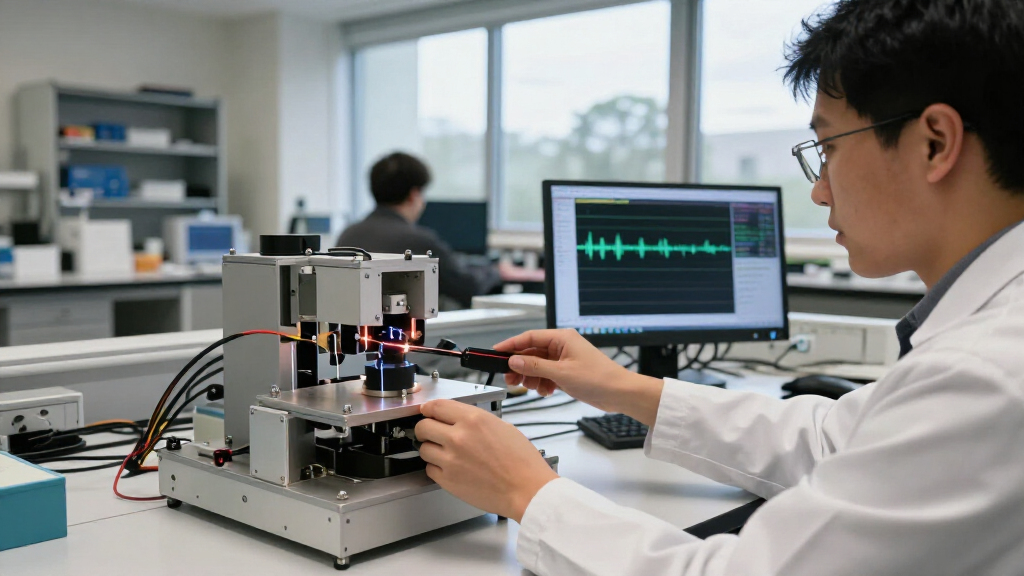
Adelaide University researchers have experimentally demonstrated a superconducting sensor design that can identify an absolute zero magnetic field without using arrays of differently sized loops. Their approach uses carefully positioned loops without Josephson junctions, but further testing is needed before commercial use.
Adelaide University researchers have developed and experimentally demonstrated a superconducting sensor design that identifies when a magnetic field is zero while preserving conditions needed for high sensitivity. The approach replaces selected elements in a sensor array with bare superconducting loops, offering an alternative to complex arrays of differently sized loops used to address the same measurement problem.
The work concerns superconducting quantum interference devices (SQUIDs), highly sensitive magnetic-field detectors used in specialised settings such as brain imaging, scientific instruments and radio-frequency sensing. According to the researchers, conventional SQUID arrays can detect very small magnetic changes but have difficulty identifying an absolute zero field. Earlier designs addressed this by combining hundreds or thousands of loops of different sizes, a complexity that can reduce overall sensitivity.
In the Adelaide design, the loops remain the same size, but some are made “bare” by omitting Josephson junctions, components used in traditional SQUID devices. The researchers say this changes how magnetic signals pass through the circuit, creating what they call a “synthetic area spread.” In effect, the array behaves as if it contained loops of multiple sizes, without requiring those different physical dimensions.
The team developed a theoretical account of the design and tested it in fabricated superconducting circuits operating at very low temperatures. The reported experimental results matched the predicted behaviour. The study, titled “Synthetic areas spread in two-dimensional Superconducting Quantum Interference Filter Arrays,” was published in Physical Review Applied on November 2, 2026. The concept is also the subject of an international patent application, according to the source report.
A Simpler Route to Zero-Field Detection
Identifying an absolute zero magnetic field matters because a sensor’s reading is more useful when it can distinguish a true zero from a small field offset. The researchers’ design aims to address that challenge without the large assortment of loop sizes used in earlier approaches, while retaining conditions they say are needed for high sensitivity.
If further work confirms the benefits across practical devices, the method could make some superconducting sensor arrays simpler to fabricate. That could be relevant to developers of sensitive brain-monitoring equipment, radio-frequency receivers, low-noise communications systems and other electromagnetic sensing platforms. These are potential applications, not established outcomes of the current experiment. The report does not provide evidence that the design has yet improved clinical measurements or commercial products.
The work also speaks to a broader engineering challenge: pushing sensors toward the quantum limit of detection while keeping device construction manageable. Fewer requirements for differently sized loops could ease fabrication, but whether that translates into lower cost, better performance or reliable production at scale remains to be tested.
Products Worth Considering

Amazon Kindle Scribe Colorsoft, 64GB, 11-Inch Color Display with Premium Pen
Logitech MX Brio Ultra HD 4K Webcam, Graphite

Apple AirPods Pro 3 Wireless Earbuds with Active Noise Cancellation
As an affiliate, we earn on qualifying purchases.
How SQUID Arrays Address Field Measurements
SQUIDs use superconducting circuits to detect magnetic-field changes, including signals too weak for many conventional instruments. The source report identifies applications in brain imaging, scientific measurement and advanced radio-frequency sensors. Their sensitivity makes accurate calibration and interpretation of readings important, including the ability to identify a zero-field point.
According to the report, previous solutions used arrays containing loops with different areas. That strategy can help identify an absolute field, but the associated design complexity can come at a sensitivity cost. Adelaide’s alternative does not make the loops different sizes; it changes the circuit by leaving Josephson junctions out of selected loops. The study reports a theoretical proposal and experimental demonstration, not a finished sensor system ready for routine use.
““Our work shows there is another way. By introducing carefully positioned bare loops, we can achieve the same result while preserving the conditions needed for maximum sensitivity.””
— Associate Professor Giuseppe Tettamanzi, lead researcher and member of Adelaide University’s School of Chemical Engineering
Performance Beyond the Laboratory
The reported experiment does not establish how the design will perform in a finished sensor used outside the laboratory. The source says further testing is required before commercialization, but does not give a timetable, performance figures or a comparison of sensitivity against existing devices under real-world operating conditions.
It is also not clear whether the proposed manufacturing simplification will reduce production costs, how robust the circuits will be across different devices, or which potential applications are most likely to benefit first. The patent application is reported, but its status and scope are not specified. Claims about future medical, communications or industrial uses should therefore be treated as possibilities under investigation, rather than demonstrated capabilities.
Further Tests and Application Studies
The researchers say further studies are underway to improve device performance and examine possible applications. The next evidence to watch for includes measurements showing how sensitivity and zero-field identification compare with existing designs, as well as tests of reliability and reproducibility across fabricated circuits.
Progress toward commercialization will depend on those results and on whether the design can be incorporated into practical systems. The source report gives no release schedule or named commercial partner. For now, the advance is an experimentally demonstrated circuit approach, with its real-world performance and adoption still to be established.
Key Questions
What did the Adelaide researchers develop?
They developed and experimentally tested a SQUID-array design that uses same-sized superconducting loops, with selected loops made bare by omitting Josephson junctions. The team says the arrangement lets the sensor identify an absolute zero magnetic field while preserving conditions for high sensitivity.
What is a bare superconducting loop?
In this study, a bare loop is a superconducting loop without Josephson junctions, a key component in traditional SQUID devices. The researchers say placing these loops strategically changes how magnetic signals move through the circuit.
Has the sensor been tested outside the laboratory?
The source reports experimental tests using fabricated circuits operating at very low temperatures. It does not report testing in clinical, industrial or other field settings, and says further testing is required before commercialization.
Could the design be used in brain imaging or communications?
The researchers identify brain monitoring, radio-frequency receivers, low-noise communications and electromagnetic sensing as potential applications. The reported work does not show that the design is already in use in those systems.
What happens next?
The team says it is continuing studies to improve performance and explore applications. Further comparisons, reliability tests and evidence of practical manufacturing would be needed to judge whether the design can move toward commercial use.
Source: thequantuminsider.com