
Using Docker to manage applications on your VPS lets you create lightweight, isolated containers that simplify deployment and improve security. You can run multiple apps securely, scale easily, and guarantee consistency across environments. Docker’s quick start, combined with best practices for data persistence, container security, and automation, helps you streamline updates and minimize downtime. Keep going, and you’ll discover how to optimize your container setups and make your workflows even more efficient.

Get business pricing on networking and server gear
- Business-only prices and quantity discounts
- Tax-exempt purchasing
- Multiple users, one account, clear invoices
Key Takeaways
- Install Docker on your VPS to create isolated, lightweight containers for each application, enhancing security and resource efficiency.
- Use Docker Compose to automate multi-container setups, simplifying deployment and management of complex applications.
- Leverage Docker volumes and bind mounts for persistent data storage and seamless host-container data sharing.
- Implement security best practices by running containers as non-root users and applying security profiles like Seccomp and AppArmor.
- Integrate Docker with CI/CD pipelines to automate building, testing, and deploying applications efficiently on your VPS.
As an affiliate, we earn on qualifying purchases.
Benefits of Containerization on Your VPS

Containerization offers significant advantages for managing applications on your VPS, primarily through enhanced isolation and security. With containers, each application runs in its own sandbox, preventing conflicts and boosting system stability. This isolation also minimizes security risks, as breaches inside one container don’t easily spread to others or the host system. Built-in features like namespace and cgroup isolation further strengthen security measures, supporting safer multitenancy. Containers reduce attack surfaces compared to traditional deployments, improving your overall security posture. Additionally, since containers are lightweight and share the host OS kernel, they consume fewer resources, enabling you to run more applications efficiently. This approach guarantees your VPS remains stable, secure, and capable of handling multiple workloads seamlessly. Incorporating Yoga techniques into your routine can also promote mental clarity and stress reduction, enhancing your overall productivity and well-being. Emphasizing container management tools can further streamline deployment and maintenance processes for your applications, and understanding application isolation principles is key to maximizing container benefits. Using resource-efficient virtualization techniques can optimize your infrastructure and reduce overhead.
As an affiliate, we earn on qualifying purchases.
Setting Up Docker on a Virtual Private Server

Setting up Docker on your VPS involves several essential steps to guarantee a smooth and secure installation. First, ensure your VPS meets system requirements: at least 2 vCPUs, 4 GB RAM, and 100 GB NVMe storage for peak performance. While Docker can run with less RAM, 2 GB or more is recommended for stability. Choose a modern, high-performance VPS with SSD or NVMe storage for faster I/O. Connect via SSH with root or sudo privileges, then install prerequisites like `curl`. Use Docker’s official installation script or package repositories compatible with your Linux distribution, such as Ubuntu or CentOS. After installation, start and enable the Docker service with `systemctl`. Additionally, container security best practices should be incorporated to protect your environment from vulnerabilities. Implementing proper user permissions can further enhance security and prevent unauthorized access. Regularly updating Docker and monitoring security patches are crucial for maintaining a secure environment. Finally, verify your setup by running `sudo docker run hello-world` to confirm Docker operates correctly.
Docker Compose multi-container setup
As an affiliate, we earn on qualifying purchases.
As an affiliate, we earn on qualifying purchases.
Designing Effective Docker Containers
Designing effective Docker containers requires a focus on simplicity and purpose. You should limit each container to a single process or application, making troubleshooting easier and enhancing modularity. Avoid embedding persistent data; instead, use volumes for shared, durable storage. Keep images minimal with multi-stage builds, reducing resource use and speeding deployment. Containers should be fast-launching and disposable, supporting automation and preventing bloat. Additionally, adhering to best practices in container security helps protect your environment.
Docker volumes for data persistence
As an affiliate, we earn on qualifying purchases.
As an affiliate, we earn on qualifying purchases.
Managing Persistent Data in Containerized Environments

Managing persistent data in containerized environments is essential for maintaining application state and ensuring data durability beyond the lifecycle of individual containers. Docker volumes provide independent storage, so your data remains intact even if containers are deleted. Named volumes are easy to manage and share between containers, created with the `docker volume create` command. Attach these volumes using the `-v` flag during container setup. For development, bind mounts let you access and modify host files directly inside containers, enabling rapid testing. However, they pose security risks and are best suited for development environments. To safeguard your data, implement regular backups, encrypt sensitive information, and enforce strict access controls. Use tools like Docker Compose or Docker Desktop Dashboard for simplified volume management and monitoring. Understanding storage options can help you optimize data management strategies for your containerized applications.
Scaling and Orchestrating Applications With Docker
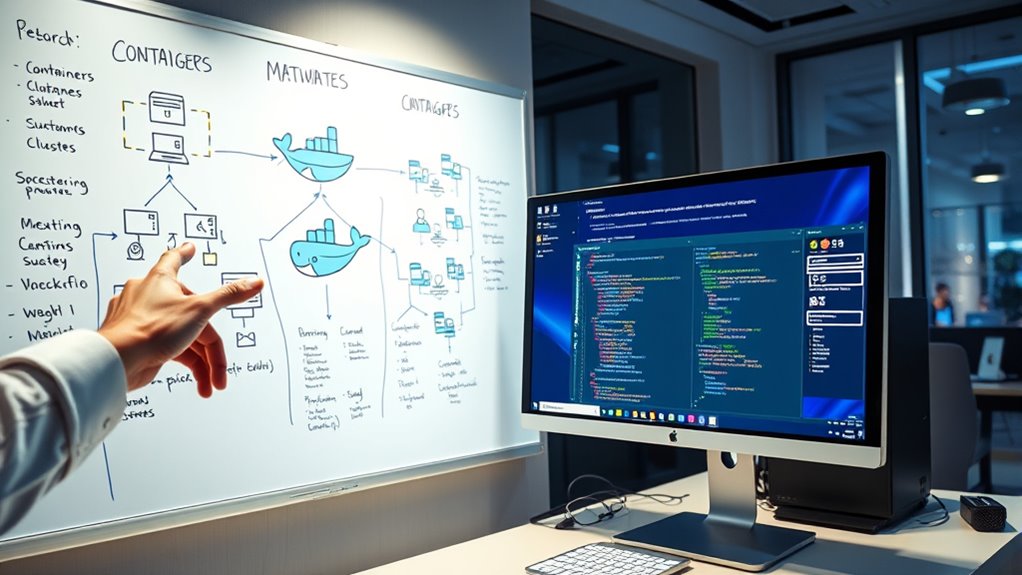
Scaling and orchestrating applications with Docker enables you to efficiently run and manage multiple containers across diverse environments. Kubernetes provides scalable, flexible orchestration, supporting tens of thousands of nodes for complex deployments with features like auto-scaling, load balancing, and rollout management. It handles service discovery and load balancing natively, ideal for microservices architectures, and supports multi-cloud and hybrid setups, offering extensive ecosystem integrations for monitoring, security, and CI/CD. Docker Swarm offers simplicity and seamless Docker integration, making it suitable for smaller deployments under 200 containers. It includes built-in load balancing, service discovery, and encrypted communication, but is less scalable and feature-rich than Kubernetes. HashiCorp Nomad provides a lightweight, versatile scheduler that supports both containerized and non-containerized workloads, suitable for hybrid and on-prem environments.
Security Best Practices for Docker on VPS

To keep your Docker environment secure, start by using trusted, minimal base images and regularly scan them for vulnerabilities. You should also limit container privileges by running processes as non-root users and dropping unnecessary capabilities. Implementing these practices helps reduce attack surfaces and protects your VPS from potential exploits. Additionally, incorporating Free Floating techniques in your container management can promote more flexible and scalable deployment strategies.
Harden Base Images
Hardened base images form the foundation of a secure Docker environment on your VPS, so choosing the right ones is essential. Use minimal base images like Alpine to reduce the attack surface by including fewer OS packages. Opt for official images labeled “Docker Official Image” or “Verified Publisher” to guarantee security standards. Avoid large, complex images with unnecessary components, which increase vulnerabilities and size. Select specific tags or immutable SHA256 digests for consistent, predictable builds, preventing unexpected changes. Mirroring trusted, hardened images into private registries gives you control and immutability. Regularly update and rebuild images to eliminate deprecated software. Additionally, considering the Entertainment and Parks hours can help in planning maintenance windows for updates and ensuring minimal downtime. Implementing security best practices such as scanning images for vulnerabilities and using role-based access controls further enhances your container security. By carefully choosing and managing your base images, you lay a strong foundation that enhances your container security and reduces potential attack vectors. Incorporating container orchestration tools can also improve deployment consistency and security.
Scan for Vulnerabilities
Implementing regular vulnerability scans is a key step in maintaining a secure Docker environment on your VPS. Automated tools like Snyk, Aqua Trivy, and Anchore help you detect known vulnerabilities in container images before deployment, reducing potential exploits. Integrate these scanners into your CI/CD pipelines to enable continuous security checks, stopping problematic merges or deployments early. Deep, recursive, and multi-layer scanning uncover hidden issues across all image layers, including base images and dependencies. Additionally, include configuration and secret scanning to identify insecure settings and exposed credentials, preventing data leaks and compliance violations. Keep your vulnerability database updated through community and commercial support, ensuring your scans catch the latest threats. Regular vulnerability assessments are essential for maintaining a resilient, secure Docker environment on your VPS. Staying informed about threat evolution and implementing proactive scanning practices can significantly enhance your security posture. Incorporating security best practices into your routine helps you adapt to emerging risks and maintain a robust defense. Regularly reviewing and updating your security protocols ensures your environment remains protected against new vulnerabilities.
Limit Container Privileges
Limiting container privileges is essential for securing your Docker environment on a VPS. You should run containers using non-root users, set via the Dockerfile USER instruction or runtime configuration, to reduce risks from root-level access. Switch to root only temporarily for privileged operations during image builds, then revert to non-root to follow the least privilege principle. Kubernetes enforces non-root execution with MustRunAsNonRoot, requiring containers to run as a non-zero UID. Avoid root containers to prevent permission issues and maintain proper file access. Use security options like `–security-opt=no-new-privileges` or `allowPrivilegeEscalation: false` in Kubernetes to prevent privilege escalation. Drop unnecessary Linux capabilities with `–cap-drop` and utilize AppArmor or Seccomp profiles for additional restrictions, substantially reducing potential attack surfaces. Additionally, adhering to vetted safety practices ensures that your containerized applications remain secure and compliant with recommended standards. Implementing container security best practices can further enhance your environment’s resilience against vulnerabilities, including leveraging security profiles to fine-tune container permissions. Ensuring proper container isolation is also crucial to limit the impact of potential breaches and maintain a secure environment.
Automating Deployment and Workflow Optimization

Automating your deployment processes saves time and reduces errors, making your workflow more reliable. By integrating CI/CD tools like Jenkins or GitHub Actions, you can guarantee consistent, rapid delivery of updates. Streamlining these steps helps you respond quickly to changes and maintain high-quality applications. Leveraging automation features further enhances efficiency by reducing manual tasks and enabling more consistent performance. Incorporating content management systems into your automation workflows can help organize and update your deployment processes more effectively. Additionally, integrating cultural and regional breakfast traditions into your planning can also inspire innovative features in your automation workflows. Incorporating essential oils into your health routines can support team well-being, enhancing overall productivity and focus within your development environment.
Streamlining Deployment Processes
Streamlining deployment processes with Docker on your VPS involves leveraging powerful automation tools and workflows that reduce manual effort and minimize errors. Automation tools like Kubernetes, Docker Swarm, Jenkins, and GitLab CI/CD build images, run tests, and push stable versions automatically, speeding up deployment cycles. Using verified Docker image versions guarantees consistency and transparency, preventing unexpected issues. Container orchestration automates scaling and lifecycle management, with Kubernetes suited for large-scale needs and Swarm ideal for smaller projects. Automation reduces deployment time by up to 50%, improving efficiency. Integrating vulnerability scans and automated testing early in the pipeline catches issues before deployment, boosting security. Employing best practices in application management ensures reliable, repeatable workflows, allowing you to deploy updates faster and with greater confidence.
Enhancing Continuous Delivery
Building on the automation practices from deployment processes, enhancing continuous delivery with Docker involves integrating automated workflows that accelerate and stabilize software releases. Automated deployment systems can cut deployment time by up to 98%, boosting developer productivity and reducing errors. Docker streamlines this further by packaging applications with their dependencies, ensuring consistency across environments and minimizing compatibility issues. Container orchestration platforms improve workflow by scheduling workloads efficiently, increasing container density, and enabling rapid container churn, which supports continuous integration and delivery. Automated CI/CD pipelines, like Jenkins or GitLab, automate building, testing, deploying, and rolling back containerized applications, making releases faster and more reliable. These integrations allow you to respond swiftly to issues, reduce downtime, and optimize resource utilization, ensuring a smoother, more resilient delivery process.
Frequently Asked Questions
How Does Docker Compare to Traditional Virtual Machines in Resource Usage?
You’ll find Docker uses fewer resources than traditional virtual machines because containers share your host OS kernel, avoiding the need for full OS installations. They’re lightweight, starting quickly, and dynamically allocate resources based on demand, unlike VMs that reserve fixed resources and take longer to boot. This efficiency means you can run more containers on the same hardware, making your setup more scalable and cost-effective without sacrificing performance.
What Are the Best Practices for Docker Image Security?
You should always use trusted, verified images from official sources and prefer minimal base images like Alpine Linux. Regularly update your images, sign them for authenticity, and generate SBOMs for transparency. Scan images for vulnerabilities, document their provenance, and deploy them securely. Run containers with non-root users, limit capabilities, and use namespace remapping. Secure your data with Docker Secrets and continuously monitor your environment to detect and respond to threats effectively.
How Can I Troubleshoot Container Performance Issues Effectively?
Oh, you’re just dying to find out why your containers are sluggish, right? First, run `docker stats` to catch the culprits hogging CPU or memory. Then, peek into logs with `docker logs` to spot errors. Use `docker exec` to investigate inside containers, and monitor network and disk I/O. Clean up unused resources regularly, and don’t forget to tweak resource limits to keep performance snappy.
What Tools Are Recommended for Docker Container Orchestration?
You should consider tools like Docker Swarm for simple, small-scale orchestration, as it integrates seamlessly with Docker and is easy to set up. For larger, more complex deployments, Kubernetes is the industry standard, offering advanced features like automatic scaling and self-healing. HashiCorp Nomad works well if you need to support multiple workload types beyond containers. OpenShift and Rancher provide enterprise-grade solutions with added security and multi-cluster management.
How Do I Handle Data Backup and Recovery in Docker Environments?
Think of your Docker environment as a ship sailing through stormy seas—your data is the cargo that needs safeguarding. You back it up by creating snapshots of volumes with temporary containers, then storing these safely offsite or in the cloud. Automate this process with scripts and cron jobs, and follow the 3-2-1 rule to guarantee recoverability. Regularly test your backups so your cargo remains secure no matter the storm.
Conclusion
Don’t let worries about complexity hold you back. With Docker, managing your applications on a VPS becomes simpler, faster, and more reliable. Yes, it takes some learning, but the benefits—easy updates, scalability, and security—are worth the effort. Imagine the confidence you’ll gain as your environment becomes more efficient and resilient. Start today, and transform your VPS into a powerful, flexible platform that grows with you. Your future self will thank you for making the leap.
Fall Picks
fall essentials
As an affiliate, we earn on qualifying purchases.