
Dedicated GPU server hosting gives you exclusive access to GPU hardware for workloads such as AI inference, model training, rendering, and scientific computing. My best overall pick is the ASUS Dual EPYC server with eight RTX Pro 6000 GPUs, thanks to its unusually large GPU memory pool and modern, high-capacity configuration. The Supermicro AS-4124GS-TNR stands out for multi-GPU workloads at a more established enterprise-server scale, while the NIMO AI NAS and Server is a more approachable choice for smaller projects. The main tradeoffs are GPU generation and memory, total system capacity, and the added work of operating a physical server rather than renting a managed cloud instance. Read on for the full comparison and help matching a server to your workload.

Get business pricing on networking and server gear
- Business-only prices and quantity discounts
- Tax-exempt purchasing
- Multiple users, one account, clear invoices
Key Takeaways
- The ASUS server leads on scale: its eight RTX Pro 6000 GPUs and 768GB total GPU memory make it the standout for large, parallel workloads, but its specialized hardware demands careful planning.
- The Supermicro system is the strongest enterprise-style alternative: dual EPYC CPUs and two 32GB Tesla V100 GPUs support substantial compute, though its listed 32GB of system RAM may require an upgrade for many workloads.
- GPU memory matters as much as GPU count: the Dell R740xd with Tesla T4 offers a different fit from the V100 and K80 systems; buyers should match the card’s memory and software support to their actual model or application.
- Older renewed systems trade modernity for established server formats: the Dell C4130 with dual Tesla K80 GPUs and the R740xd with a V100 can suit defined legacy or compute tasks, but age and renewed condition call for closer checks on support and parts.
- The NIMO is the approachable small-project option, not a rack-scale substitute: its Ryzen 7 PRO, 32GB RAM, and RTX 5060 suit lighter local workloads, while the TYAN EPYC system is a platform-led pick whose final fit depends on its GPU configuration and support details.



| dedicated GPU server hosting | Processors | Memory | Form factor | Networking |
|---|---|---|---|---|
| Dell PowerEdge R740xd 2U Rack | 2 × Intel Xeon Platinum 8168, 24 cores each | 384GB PC4-21300-R, 2666MHz | 2U rack server | Dual-port 25Gb SFP28 |
| TYAN FT65TB8030 EPYC GPU Serve | — | — | — | — |
| NIMO AI NAS and Server with AM | — | — | — | Dual 10GbE |
| Dell PowerEdge C4130 Server wi | 2 × Intel Xeon E5-2623 v3, quad-core, 3GHz | 32GB ECC DDR4; maximum 1TB | — | — |
| Supermicro A+ Server AS-4124GS | 2 × AMD EPYC 7742, 64 cores each, 2.25GHz | 32GB DDR4, 2 × 16GB | 5U rack server | — |
| Dell EMC PowerEdge R740xd 2U S | 2 x Intel Xeon Platinum 8168, 2.7 GHz, 24 cores each | 64GB DDR4 (2 x 32GB) | 2U rack server | 2 x 10GbE SFP+ and 2 x 1GbE |
| ASUS Dual EPYC 9965 192-Core C | 2 x AMD EPYC 9005, up to 192 Zen 5c cores | 2304GB DDR5 ECC RDIMM, 3200MHz | 4U rackmount | Options listed up to ten 200GbE NICs |
More Details on Our Top Picks
Dell PowerEdge R740xd 2U Rack Server, 48-Core Xeon, 384GB RAM, 1.9TB SSD, Tesla V100 GPU (Renewed)
I rank this R740xd as the most balanced ready-configured option here: it pairs a 32GB Tesla V100 with 48 Xeon cores and 384GB of memory, so the host has more room for data preparation and concurrent services than the C4130’s 32GB configuration. Its dual-port 25Gb networking also suits workloads that move datasets between the server and fast storage. Compared with the Supermicro AS-4124GS-TNR, this Dell arrives with one GPU rather than two, but it also avoids that model’s especially lean 32GB system-memory configuration. The tradeoff is that this is a renewed, single-GPU system, and the listed drives are SAS SSDs—not NVMe. Software is not included, so buyers need to plan the operating system, drivers, and deployment work themselves.
Pros:- 32GB NVIDIA Tesla V100 provides dedicated accelerator memory for compatible GPU workloads.
- 384GB RAM and 48 CPU cores support data handling and parallel host-side tasks.
- Dual-port 25Gb SFP28 networking can support high-throughput links to shared storage.
- Redundant 1600W power supplies, sliding rails, and a one-year warranty are listed.
Cons:- Only one GPU is included, unlike the dual-V100 Supermicro AS-4124GS-TNR.
- The supplied 1.9TB drives are SAS SSDs rather than NVMe.
- Renewed hardware and the absence of included software call for deployment and condition checks.
Best for: Small AI or GPU-compute teams seeking a rack server with one V100, substantial host memory, and fast network connectivity in a supplied configuration.
Not ideal for: Operators who need multiple GPUs, NVMe storage specifically, or a turnkey software stack; the system has one V100, SAS SSDs, and no software included.
- Form factor:2U rack server
- Processors:2 × Intel Xeon Platinum 8168, 24 cores each
- Total CPU cores:48
- Memory:384GB PC4-21300-R, 2666MHz
- GPU:NVIDIA Tesla V100, 32GB HBM2
- Storage:2 × 960GB SAS 12G SSDs; 1.9TB total
- Networking:Dual-port 25Gb SFP28
- Power:2 × 1600W Platinum power supplies
- Condition and warranty:Renewed; one-year warranty
Our verdict“Choose this R740xd if you want a well-provisioned single-V100 server with ample RAM, but skip it if multi-GPU capacity or NVMe drives are requirements.”
TYAN FT65TB8030 EPYC GPU Server
The TYAN’s strongest case is its GPU expansion headroom: the platform supports up to four double-wide x16 cards across as many as six PCIe Gen4 slots. That makes it a more flexible starting point for a multi-accelerator build than the single-V100 Dell R740xd, while its U.2 NVMe bays provide a faster storage path than that Dell’s listed SAS SSDs. This is a platform choice, not a fully specified ready-to-run GPU host: the listing does not name an EPYC model, installed memory capacity, GPU, or power and cooling details. Buyers must verify those parts before planning a workload. Its single-socket design also limits CPU expansion compared with the dual-socket Supermicro AS-4124GS-TNR, so the TYAN makes most sense when PCIe capacity matters more than a second processor socket.
Pros:- Supports up to four double-wide x16 GPUs for a scalable accelerator build.
- Up to six PCIe Gen4 slots offer expansion flexibility.
- Two hot-swap U.2 NVMe bays allow high-speed storage alongside SATA options.
- Eight memory channels and eight DDR4-3200 slots provide a clear platform for memory configuration.
Cons:- No installed GPU, CPU model, or memory capacity is specified in the supplied product details.
- Single-socket architecture does not offer the dual-CPU expansion available in the Supermicro AS-4124GS-TNR.
- Power supply and cooling specifications are absent, making system planning harder.
Best for: Server builders planning a custom EPYC-based multi-GPU host who can select and verify the CPU, memory, accelerators, power, and cooling configuration.
Not ideal for: Teams needing a specified, ready-to-deploy GPU server or a dual-socket CPU platform; key installed components and power and cooling details are not provided.
- CPU platform:Single-socket AMD EPYC
- Memory type:DDR4-3200
- Memory slots and channels:8 slots across 8 channels
- PCIe expansion:Up to 6 PCIe Gen4 slots
- GPU support:Up to 4 double-wide x16 GPUs
- 3.5-inch bays:2 hot-swap SATA
- 2.5-inch bays:2 hot-swap U.2 NVMe
- Warranty:Full warranty
Our verdict“Pick the TYAN as a configurable foundation for a multi-GPU build, not as a complete server with a confirmed GPU and deployment-ready specification.”
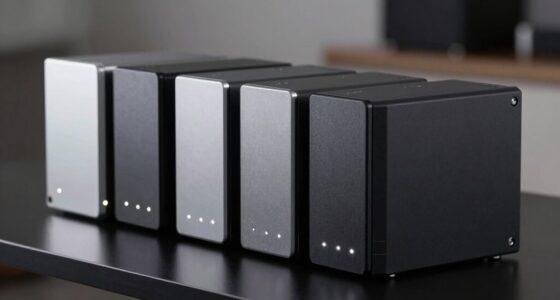
NIMO AI NAS and Server with AMD Ryzen 7 PRO 8845HS, 32GB DDR5 RAM, and NVIDIA RTX 5060
The NIMO is the compact, storage-centered choice rather than a conventional rack GPU server. Its RTX 5060, Linux base, and dual 10GbE suit local AI experiments, media work, and shared files where keeping data on-site matters. Compared with the rack-mounted Dell R740xd, it takes up less space and advertises support for much larger ZFS storage, but it has a single expansion slot and a Ryzen 7 PRO 8845HS rather than the Dell’s 48-core Xeon host. That trade makes the NIMO a better fit for a small office or lab than for dense GPU compute or multi-card workloads. The listing also leaves important configuration questions: it gives conflicting graphics-memory details and does not state the included drive capacity. I would confirm both before treating it as a server for a defined production workload.
Pros:- Dedicated NVIDIA RTX 5060 graphics are included for local GPU workloads.
- Dual 10GbE supports fast connections to clients or network storage.
- Linux and stated Docker and virtualization use suit self-managed deployments.
- Supports up to 132TB of ZFS hybrid storage.
Cons:- The listing conflicts between 32GB system RAM and 96GB graphics RAM, so the memory details need verification.
- No included drive capacity or drive configuration is specified.
- One expansion slot and a compact platform limit growth compared with rack GPU systems such as the TYAN.
Best for: Small teams or technically confident home-lab users who want a compact Linux system for local AI, media tasks, and networked storage.
Not ideal for: GPU hosting operators who need a rackmount chassis, multiple expansion GPUs, a confirmed memory configuration, or specified included storage.
- Processor:AMD Ryzen 7 PRO 8845HS
- System memory:32GB DDR5 RAM listed
- Graphics:NVIDIA GeForce RTX 5060
- Maximum stated storage:Up to 132TB ZFS hybrid storage
- Operating system:Linux
- Networking:Dual 10GbE
- Expansion:1 expansion slot
- Dimensions:8.58 × 7.6 × 14.65 inches
Our verdict“Choose the NIMO for compact local AI and storage duties after verifying its memory and drives, not for expandable rack-scale GPU hosting.”
Dell PowerEdge C4130 Server with Dual Xeon E5-2623 v3 CPUs, 32GB RAM, 1.6TB SSD Storage, and Dual Tesla K80 GPUs (Renewed)
This C4130 is the lineup’s clearest route to two installed GPUs without moving up to the Supermicro’s dual-V100 configuration: it includes a pair of Tesla K80 accelerators and redundant 1600W power supplies. The K80s are older-generation hardware, though, and the listed host configuration is modest at 32GB of ECC RAM and two quad-core Xeons. That makes it a narrower fit than the R740xd, which offers 384GB RAM and a newer V100, especially when a workload needs substantial CPU-side data preparation or memory. The C4130’s renewed status and 50-pound weight also suit a fixed rack deployment better than frequent moves. I’d choose it only where software compatibility with the K80 generation is confirmed and the dual-GPU setup is more important than newer accelerators or abundant host resources.
Pros:- Includes two NVIDIA Tesla K80 GPU accelerators.
- Two 800GB SSDs provide 1.6TB of listed storage.
- ECC DDR4 memory and a stated upgrade ceiling of 1TB support memory expansion.
- Redundant 1600W power supplies are included.
Cons:- The Tesla K80 generation is older than the V100 GPUs in the R740xd and Supermicro systems.
- Only 32GB of RAM and eight total CPU cores are listed in the supplied configuration.
- Renewed condition and 50-pound weight make condition checks and rack placement part of the purchase plan.
Best for: Budget-conscious labs with workloads validated for Tesla K80 GPUs that need two accelerators in a renewed rack server.
Not ideal for: Teams needing newer GPU architecture, substantial system RAM, or high CPU core counts; the R740xd has much more memory and the Supermicro pairs newer V100 GPUs.
- Model and condition:Dell PowerEdge C4130; renewed
- Processors:2 × Intel Xeon E5-2623 v3, quad-core, 3GHz
- Memory:32GB ECC DDR4; maximum 1TB
- Graphics:2 × NVIDIA Tesla K80, 24GB each
- Storage:2 × 800GB 6Gb/s uSATA SSDs; 1.6TB total
- Power supplies:2 × 1600W redundant
- Dimensions:36 × 24 × 8 inches
- Weight:50 pounds
Our verdict“Buy the C4130 only if your software supports K80s and you need a renewed dual-GPU server more than newer accelerators or stronger host specifications.”
Supermicro A+ Server AS-4124GS-TNR 5U with GeForce Lid, Dual EPYC 7742 64‑Core CPUs, 32 GB DDR4 Memory, 24 Tray Bays, Dual NVIDIA Tesla V100 32 GB GPUs, Rack Rails (Renewed)
For buyers prioritizing CPU parallelism and two substantial accelerators, the Supermicro is the lineup’s heavy-duty option: its dual 64-core EPYC processors sit alongside two 32GB Tesla V100 GPUs. That is a far larger compute platform than the NIMO’s compact Ryzen system and a more capable dual-GPU generation than the C4130’s Tesla K80 pair. The catch is the supplied configuration: just 32GB of system RAM is listed, which looks unusually sparse beside 128 CPU cores and two GPUs, and all 24 drive trays are supplied without drives. Its 5U chassis, four 2000W power supplies, and high-power components also demand suitable rack space, electrical capacity, and cooling. This makes the most sense for buyers ready to provision memory and storage, rather than anyone seeking a complete plug-in GPU server.
Pros:- Two Tesla V100 GPUs provide 64GB combined HBM2 capacity across the accelerators.
- Dual 64-core EPYC 7742 processors offer 128 CPU cores for parallel workloads.
- Twenty-four hot-swap drive trays allow a large, configurable storage build.
- Four 2000W Titanium power supplies and 4-post rack rails are listed.
Cons:- The supplied system has only 32GB DDR4 memory, which may constrain CPU- and GPU-fed workloads.
- Drive trays are included but drives are not, so storage must be sourced separately.
- The 5U, four-power-supply platform calls for substantial rack, electrical, and cooling capacity.
Best for: HPC and AI teams building a rack deployment that can use two V100 GPUs and many CPU cores, and that can add memory and drives to suit the workload.
Not ideal for: Buyers seeking a ready-to-run system, limited rack or power capacity, or a configuration with ample system RAM and included storage.
- Form factor:5U rack server
- Processors:2 × AMD EPYC 7742, 64 cores each, 2.25GHz
- Total CPU cores:128
- Memory:32GB DDR4, 2 × 16GB
- Graphics:2 × NVIDIA Tesla V100, 32GB HBM2 each
- Drive bays:24 × 2.5-inch trays; drives not included
- Power supplies:4 × 2000W 80 Plus Titanium
- Rack accessories:4-post rack rails included
- Dimensions:29 × 18 × 7 inches
Our verdict“Choose the Supermicro for a buildable dual-V100 compute platform with exceptional CPU capacity, provided you can add memory and drives and support its rack demands.”
Dell EMC PowerEdge R740xd 2U Server, Dual Xeon Platinum 8168, 64GB RAM, Tesla T4, 6x 8TB and 4x 600GB SAS Drives (Renewed)
I’d choose this renewed PowerEdge R740xd when a hosted workload needs a modest GPU alongside substantial local disk capacity. Its Tesla T4 with 16GB GDDR6 can support inference and other GPU-accelerated tasks, while six 8TB SAS drives provide room for datasets and archives without relying entirely on network storage. Dual Xeon Platinum 8168 processors add 48 CPU cores, but the included 64GB of RAM may constrain memory-hungry services unless it is expanded.
Compared with the other R740xd in this roundup, which pairs a Tesla V100 with 384GB RAM and SSD storage, this configuration favors bulk capacity over GPU and memory headroom. It is a more grounded fit for storage-oriented hosting than the eight-GPU ASUS EPYC system, which targets far larger AI and HPC jobs. The tradeoffs are its renewed condition, spinning-disk performance, and missing bezel; buyers should also confirm the T4 suits their specific acceleration workload.
Pros:- Tesla T4 provides dedicated GPU acceleration in a conventional 2U server.
- Six 8TB SAS drives offer substantial local capacity for datasets and archived workloads.
- Dual 24-core Xeon Platinum processors provide 48 CPU cores for concurrent services.
- Dual 10GbE SFP+ networking, redundant power supplies, iDRAC 9 Enterprise, and rails are included.
Cons:- The included 64GB RAM may limit virtualization, large datasets, and memory-intensive GPU workloads.
- The Tesla T4 is a single, comparatively modest GPU and is not suited to workloads needing multiple high-end accelerators.
- Renewed condition and the missing bezel may matter to buyers seeking new equipment or a complete matching chassis.
Best for: Operators hosting inference, data processing, or mixed services that need a single modest GPU and ample local SAS storage in a 2U rack server.
Not ideal for: AI teams training large models or running several demanding GPU jobs; the single Tesla T4 and 64GB of included RAM offer much less headroom than the ASUS eight-GPU server or the R740xd configured with a V100 and 384GB RAM.
- Form factor:2U rack server
- Processors:2 x Intel Xeon Platinum 8168, 2.7 GHz, 24 cores each
- Memory:64GB DDR4 (2 x 32GB)
- Graphics:NVIDIA Tesla T4, 16GB GDDR6
- Storage:6 x 8TB 7.2K SAS HDD and 4 x 600GB 10K SAS HDD
- RAID controller:Dell PERC H740p, 12Gbps, 8GB cache
- Networking:2 x 10GbE SFP+ and 2 x 1GbE
- Power:2 x 750W redundant power supplies
Our verdict“Choose this R740xd for a storage-heavy server with one GPU-accelerated workload, but pick a higher-memory, stronger-GPU configuration for intensive AI hosting.”
ASUS Dual EPYC 9965 192-Core CPU, 8x RTX Pro 6000 96GB (768GB vRAM), 4U Rackmount HPC GPU Server with 2.3TB DDR5 ECC RDIMM RAM and 8x Hot‑Swap U.2
This ASUS is the roundup’s choice for workloads that need multiple high-end GPUs, enormous memory capacity, and room to scale beyond a single accelerator. Its listed configuration pairs dual EPYC 9005 processors with up to 192 cores, 2.3TB of DDR5 ECC memory, and eight RTX Pro 6000 96GB GPUs; the product data also lists an H200 GPU option, so buyers should confirm the exact configuration before ordering. Those resources suit parallel AI and HPC jobs far better than the single-T4 R740xd.
The tradeoff is infrastructure: a 4U, 150-pound system with 3+1 3200W power supplies calls for suitable rack capacity, cooling, and electrical service. It is a far more demanding deployment than the 5U Supermicro A+ system with two V100 GPUs, and the listed Windows 11 Pro operating system may not match every server software stack. I’d reserve this for teams with enterprise deployment skills rather than first-time GPU hosts.
Pros:- Eight high-end GPU options provide much greater parallel compute capacity than the single-GPU servers in this roundup.
- 2.3TB of DDR5 ECC memory supports unusually large in-memory workloads.
- Up to 122.88TB of NVMe storage capacity and hot-swap drive options support fast, high-capacity data access.
- Redundant 3+1 Titanium power supplies and tool-less maintenance are designed for demanding rack deployments.
Cons:- The 150-pound chassis and 3200W power supplies demand substantial rack, electrical, and cooling capacity.
- Its complex, enterprise-scale configuration can be difficult for teams without server deployment expertise.
- The product description lists GPU alternatives and up to ten 200GbE NICs, so buyers need to verify the actual installed configuration and included networking.
Best for: Enterprise AI and HPC teams that can provision a high-power 4U rack system and need multiple GPUs, very large ECC memory capacity, and high-throughput storage or networking options.
Not ideal for: Small labs, first-time server operators, and hosting providers with limited rack power or cooling; the system’s weight, power requirements, and complex configuration exceed the needs of modest single-GPU workloads.
- Form factor:4U rackmount
- Processors:2 x AMD EPYC 9005, up to 192 Zen 5c cores
- Memory:2304GB DDR5 ECC RDIMM, 3200MHz
- GPU configuration:8 x NVIDIA RTX Pro 6000 96GB or H200 141GB; confirm installed configuration
- Storage capacity:Up to 122.88TB NVMe SSD across hot-swap U.2/M.2 drives
- Power supplies:3+1 3200W Titanium redundant PSUs
- Networking:Options listed up to ten 200GbE NICs
- Weight:150 pounds
- Operating system:Windows 11 Pro
Our verdict“Choose the ASUS for enterprise AI or HPC hosting that can use eight high-end GPUs and support the infrastructure; skip it for smaller or simpler GPU workloads.”

How We Picked
I ranked these options by how clearly their listed hardware fits a dedicated GPU workload, weighing GPU capability and memory alongside CPU, system RAM, storage, expandability, and the practical demands of running server hardware. I also considered how much is known from each configuration: a specified GPU and memory capacity make it easier to judge workload fit than a platform listing with limited GPU detail.
The ASUS ranks first for its exceptional eight-GPU capacity and large GPU memory pool. The Supermicro follows as a substantial multi-GPU enterprise platform, while the Dell V100 and T4 configurations offer more focused options in familiar server chassis. The NIMO earns a place for smaller deployments and simpler scale; the Dell K80 is a more specialized older-GPU option, and the TYAN’s placement reflects the need to verify its complete GPU configuration before committing. Renewed hardware and incomplete support details lower confidence, even when the listed specifications look compelling.
Factors to Consider When Choosing Dedicated GPU Server Hosting
Server specifications are only one part of the decision. I would begin with the workload, then check whether the machine can be installed, powered, cooled, maintained, and supported where it will run.
Match GPU memory and software support to the workload
Model size, batch size, and parallel jobs can make GPU memory a harder limit than raw processing speed. Before choosing a card, check the memory needed by your framework, model, and expected concurrency, then confirm that its architecture and drivers remain supported by the software you depend on. A large combined memory figure across several cards does not automatically behave like one large, unified GPU; your application may need to split work across devices. Buyers moving an existing project should verify compatibility before purchasing rather than assuming every NVIDIA GPU behaves the same way. When workloads are uncertain, a configuration with headroom can be more useful than a lower-cost server that repeatedly hits memory limits.
Decide whether you need ownership or a hosting service
A dedicated server listing and dedicated GPU server hosting are not always the same service. Hardware ownership or purchase may leave you responsible for rack space, connectivity, power, remote access, replacement parts, and physical intervention, while a hosted plan may bundle some of those tasks. Ask who handles failed components, operating-system installation, network configuration, and after-hours support before comparing options. A self-managed system can offer control over hardware and software, but that control brings operational work. If your team lacks a suitable rack or server-room setup, include colocation or managed hosting requirements in the decision from the start.
Check power, cooling, and rack constraints before ordering
Multi-GPU servers can draw substantial power and release substantial heat, so a specification sheet alone cannot confirm that a site is ready. Verify the required electrical circuits, connector types, cooling capacity, noise tolerance, and rack depth with the seller or hosting facility. A dense GPU configuration may need more airflow than a standard office or small server closet can provide. Buyers often focus on the GPU count and discover later that their location cannot run the system safely or reliably. For hosted deployment, request the provider’s power and rack requirements in writing and confirm that the chosen configuration fits its facility.
Plan system RAM, storage, and data movement as a whole
GPUs do not remove bottlenecks elsewhere in the machine. System memory affects data loading and preprocessing, while storage speed and capacity shape how quickly datasets and checkpoints move through a workflow. Large-capacity drives are useful for keeping datasets nearby, but capacity alone does not tell you whether a drive layout suits frequent reads, writes, or redundancy needs. Check how many drive bays remain available, which interfaces are supported, and whether storage is configured for resilience or only capacity. A balanced system can outperform a more GPU-heavy server when the work depends on constant data preparation or large local datasets.
Treat renewed hardware as a support and lifecycle decision
Renewed servers can provide access to capable hardware, but the listing may not answer every question about component history or future support. Confirm warranty terms, return coverage, included rails and power supplies, firmware access, and whether replacement GPUs or other parts are readily available. Older accelerator generations may still fit a stable, specific workload, yet they can limit software options or complicate a later upgrade. Ask whether the quoted configuration has been validated as a complete working system, not just assembled from individually compatible parts. If uptime matters, include spare-part access and repair turnaround in the purchase decision.
Compare total operating cost, not just the hardware line item
The cost of running a GPU server includes more than acquiring the chassis and accelerators. Power use, facility charges, network transfer, administration time, maintenance, and downtime can change the economics of a workload over its useful life. A large system makes sense when its capacity stays productively occupied, but unused GPUs still consume rack space and require care. For bursty projects, compare a fixed dedicated deployment with flexible rented capacity and factor in data movement and setup time. Buyers should estimate realistic utilization and growth before paying for more GPUs than their workloads can use.
Frequently Asked Questions
Can I use these server listings as dedicated GPU hosting without a data center?
Not automatically. A server purchase does not by itself provide rack space, power, cooling, public connectivity, or remote hands, so you need a suitable site or a colocation provider. Before ordering, confirm the chassis dimensions, power requirements, network needs, and installation support. Ask whether the seller supplies a complete ready-to-run system or only the listed hardware. If you do not already manage server infrastructure, compare the full cost and workload of self-hosting with a managed dedicated GPU service.
Is one GPU with more memory better than several GPUs?
It depends on whether your software can split its workload across multiple devices. A single GPU with sufficient memory can be simpler for applications that do not scale well across cards, while multiple GPUs can increase throughput for parallel jobs or software built for distributed execution. Total GPU memory across cards is not necessarily available as one shared pool. Check framework support, model size, and the way your application handles multi-GPU execution before deciding. A small benchmark using your real workload can reveal more than GPU count alone.
What should I verify before buying a renewed GPU server?
Confirm the warranty and return window, the condition and testing status of each GPU, and which components are included in the quoted configuration. Request details on power supplies, rails, drive trays, firmware, and any missing parts that could block deployment. Check whether the seller can support replacement components and whether the system has been tested under GPU load. Older hardware can fit a defined workload, but software compatibility and parts availability may be less predictable than with newer platforms. Keep a written record of the exact configuration and support commitments.
How can I tell whether a listed server has enough system RAM?
Estimate memory use for the operating system, data loading, preprocessing, caching, and any services that run alongside GPU jobs. GPU memory and system RAM are separate resources, so abundant VRAM does not compensate for a shortage of host memory. Workloads that stage large datasets or run several processes may need far more system RAM than a basic inference task. Check whether the configuration has open memory slots and confirm supported capacity and memory type before purchase. If the listing shows a low or unspecified amount, ask for an upgrade quote and the exact installed layout.
When does a dedicated GPU server make more sense than renting cloud GPUs?
A dedicated system can suit steady workloads that keep hardware busy, require consistent access, or depend on specific software and storage arrangements. Cloud GPUs can be easier for short projects, variable demand, and teams that want less responsibility for physical infrastructure. Compare the expected utilization period, administration effort, data transfer, and outage handling rather than looking only at compute capacity. Dedicated hardware also requires a plan for repairs and eventual replacement. If demand is uncertain, a short-term rental or workload trial can help establish the right GPU count before committing to a fixed deployment.
Conclusion
For the broadest high-capacity GPU workload, I would choose the ASUS Dual EPYC system as best overall and best premium, provided the buyer can support its demanding eight-GPU setup. The NIMO AI NAS and Server is my best choice for beginners who need a smaller system for lighter projects and do not need rack-scale capacity. For a substantial enterprise-style multi-GPU configuration, the Supermicro AS-4124GS-TNR is the strongest alternative, but I would verify its system RAM and upgrade plan. The Dell R740xd with Tesla T4 is a more focused pick for buyers whose workload fits that accelerator and who value local storage capacity; the V100 and K80 Dell systems make more sense for defined legacy or specialized tasks than as default choices for new deployments. I would treat the TYAN as a platform to investigate rather than a ready-made recommendation until its GPU configuration and support terms are confirmed. For best value, compare the NIMO’s modest scale or a renewed Dell’s workload fit against the full costs of operation rather than choosing by GPU count alone.