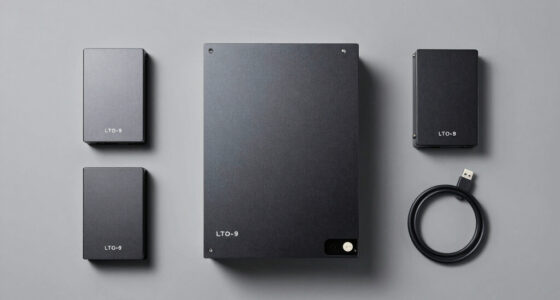
When it comes to securely erasing data from hard drives and tapes, choosing the right degausser can be challenging. The DataGauss LG Compact Continuous Degausser stands out for high throughput and simplicity, making it ideal for busy environments. Meanwhile, the DataGauss MAX-LG offers advanced features like barcode scanning and audit reports, suited for professional or enterprise settings. Both excel at fast, reliable data destruction with cycle times around 45 seconds, but they differ in their target users and feature sets, especially regarding documentation and drive compatibility.

Get business pricing on networking and server gear
- Business-only prices and quantity discounts
- Tax-exempt purchasing
- Multiple users, one account, clear invoices
Key Takeaways
- The DataGauss LG Compact is perfect for high-volume environments that prioritize speed and ease of use.
- The MAX-LG provides comprehensive documentation and supports multiple drive interfaces, fitting for regulated or audit-heavy workplaces.
- Both units offer fast cycle times, but the MAX-LG adds features like barcode scanning for better tracking.
- The compact model is limited to standard drives and tapes, while the MAX-LG handles a wider array of interfaces but is more expensive and less portable.
- Choosing the right degausser depends on your volume needs, documentation requirements, and drive types supported.
| DataGauss LG Compact Continuous Degausser |  | Best for High-Volume, Speed-Focused Environments | Media Handling: Degausses all standard hard drives & backup tapes | Media Compartment: 5.9” x 1.2” x 4.3” (150mm x 30mm x 110mm) | Degaussing Force: 9,000 max gauss | VIEW ON AMAZON | See Our Full Breakdown |
| DataGauss MAX-LG Hard Drive Degauss eraser with Barcode Scanner and Log Report |  | Best for Professional, Audit-Ready Data Destruction | Hard Drive Interface: SATA, IDE, SCSI, FC | Erasure Time: 45 seconds | Magnetic Force: 10,000 Gauss | VIEW ON AMAZON | See Our Full Breakdown |
| data destruction degausser | Throughput | Media Handling | Media Compartment | Degaussing Force |
|---|---|---|---|---|
| DataGauss LG Compact Continuou | 70 hard drives/cartridges per hour | Degausses all standard hard drives & backup tapes | 5.9” x 1.2” x 4.3” (150mm x 30mm x 110mm) | 9,000 max gauss |
| DataGauss MAX-LG Hard Drive De | 70 drives/tapes per hour | — | — | — |
More Details on Our Top Picks
DataGauss LG Compact Continuous Degausser
The DataGauss LG Compact Continuous Degausser excels at quickly erasing all standard hard drives and backup tapes, making it an excellent choice for organizations that process large quantities daily. Its 9,000 gauss magnetic force ensures complete erasure, while a cycle time of just 45 seconds allows for high throughput—up to 70 drives or tapes per hour. The inclusion of an LCD display and straightforward controls makes operation intuitive. Compared with more feature-heavy models, it lacks advanced logging or barcode capabilities, which could be a drawback for environments requiring strict documentation. Nevertheless, its efficiency and simplicity make it ideal for data centers or IT departments focused on volume.
Pros:- Fast cycle time with high throughput
- User-friendly LCD controls
- Effective for standard hard drives and tapes
- Compatible with multiple Windows OS
Cons:- Limited to standard hard drives and tapes
- No advanced documentation or logging features
- No portable or wireless options
Best for: Organizations handling large volumes of drives needing quick, reliable erasure.
Not ideal for: Small offices or environments requiring detailed audit trails and documentation.
- Media Handling:Degausses all standard hard drives & backup tapes
- Media Compartment:5.9” x 1.2” x 4.3” (150mm x 30mm x 110mm)
- Degaussing Force:9,000 max gauss
- Cycle Time:45 seconds typical
- Throughput:70 hard drives/cartridges per hour
- Controls:On/Off power switch, erase button, LCD display
- Compatible OS:Windows 10, 8, 7, Vista, XP SP3 or higher
Our verdict“This model is best suited for high-volume operations prioritizing speed and efficiency over detailed tracking.”
DataGauss MAX-LG Hard Drive Degauss eraser with Barcode Scanner and Log Report
The DataGauss MAX-LG offers a high level of assurance with 10,000 gauss magnetic force, capable of erasing SATA, IDE, SCSI, and FC drives. Its 45-second cycle time ensures quick results, but where it truly stands out is in its added features—barcode scanning and automatic log report generation. These capabilities make it ideal for organizations that need to comply with strict data destruction regulations or require detailed audit trails. Its self-calibrating system ensures consistent performance, but the device’s bulk and need for external peripherals like a printer and laptop make it less portable and suitable mainly for professional environments.
Pros:- Fast and reliable 45-second erasure
- Includes barcode scanner and audit report features
- Supports multiple drive interfaces (SATA, IDE, SCSI, FC)
- Self-calibrating for consistent performance
Cons:- Requires additional peripherals (printer, laptop)
- Less portable due to size and setup complexity
- No reuse of drives post-erasure
Best for: Enterprises or regulated industries needing documented, verifiable data erasure.
Not ideal for: Small operations or casual users who don’t require audit features or multi-interface support.
- Hard Drive Interface:SATA, IDE, SCSI, FC
- Erasure Time:45 seconds
- Magnetic Force:10,000 Gauss
- Throughput:70 drives/tapes per hour
- Includes:Barcode Scanner, Data Destruction Auditor
Our verdict“Best suited for professional settings where documentation and compliance are critical, despite higher setup requirements.”

How We Picked
Our selection process focused on degaussers that combine effective magnetic erasure with practical features for different user needs. We prioritized cycle times of around 45 seconds to ensure fast throughput and looked for devices capable of handling common media like hard drives and tapes. Compatibility with various drive interfaces, ease of operation, and additional features such as audit logging or barcode scanning also influenced our choices. We aimed to balance high performance with usability, considering both professional environments and smaller-scale operations.
Factors to Consider When Choosing Data Destruction Degausser
Selecting the right degausser depends on your specific needs around speed, media types, documentation, and budget. Understanding your typical volume, regulatory compliance requirements, and whether you need detailed logs or simple erasure will guide your choice. Both high-performance models here offer cycle times around 45 seconds but serve different operational contexts. Let’s explore key factors to consider before making a purchase.
Volume and Speed Needs
If your organization processes a large number of drives daily, a degausser with high throughput and fast cycle times, like the DataGauss LG Compact, is essential. For smaller volumes, speed may be less critical, but reliability and ease of use should take precedence. The ability to handle multiple drives per hour can significantly impact operational efficiency.
Media Compatibility and Types
Assess whether your media includes standard hard drives, backup tapes, or more specialized interfaces like SCSI or FC. The LG Compact handles standard drives and tapes well, while the MAX-LG supports a broader range of interfaces, making it more versatile for mixed environments.
Documentation and Compliance
For organizations subject to strict data disposal regulations, features like barcode scanning, audit logs, and report generation become vital. The MAX-LG leads in this area, offering built-in reporting tools, whereas the LG Compact is more straightforward and suited for internal use where documentation is less critical.
Portability and Setup
Consider whether you need a portable, standalone unit or a more permanent setup. The LG Compact is more compact and easier to relocate, while the MAX-LG’s setup complexity makes it better for dedicated, professional environments.
Frequently Asked Questions
What is degaussing and how does it destroy data?
Degaussing involves generating a strong magnetic field that disrupts the magnetic domains on a hard drive or tape, effectively erasing all stored data. This process renders the media unreadable and unrecoverable, providing a secure method of data destruction compliant with many data privacy standards.
Can degaussing be used on all types of drives?
While degaussing is effective on most magnetic media, its efficacy depends on the magnetic force and media type. Standard hard drives and tapes respond well, especially with higher gauss levels like those in the MAX-LG. Solid-state drives (SSDs) and other non-magnetic media are unaffected, so degaussing is not suitable for these types.
How important is the gauss rating in choosing a degausser?
The gauss rating indicates the magnetic strength of the degausser. Higher gauss levels, such as 10,000 gauss in the MAX-LG, ensure more reliable erasure of hard drives, especially those with higher magnetic shielding. For standard drives, 9,000 gauss often suffices, but for more secure or resistant media, higher ratings are advisable.
Are degaussers compliant with data destruction regulations?
Many degaussers, particularly those with audit logging and reporting features like the MAX-LG, are designed to meet strict compliance standards. They produce verifiable logs and reports that demonstrate data has been securely wiped, which is essential for audits and legal requirements.
Is degaussing a permanent solution for data destruction?
Yes, degaussing provides a permanent, non-recoverable erasure of magnetic data. After degaussing, drives cannot be reused or recovered without specialized equipment, making it a trusted method for secure data disposal in sensitive environments.
Conclusion
For organizations with high-volume needs and less emphasis on documentation, the DataGauss LG Compact offers fast, efficient erasure. Meanwhile, for regulated industries or those requiring detailed audit trails, the DataGauss MAX-LG provides comprehensive logging and support for multiple media types, despite its higher cost and setup complexity. Your choice should align with your volume, compliance requirements, and whether ease of use or detailed documentation is more important.
Evergreen bestsellers Picks
bestsellers
As an affiliate, we earn on qualifying purchases.