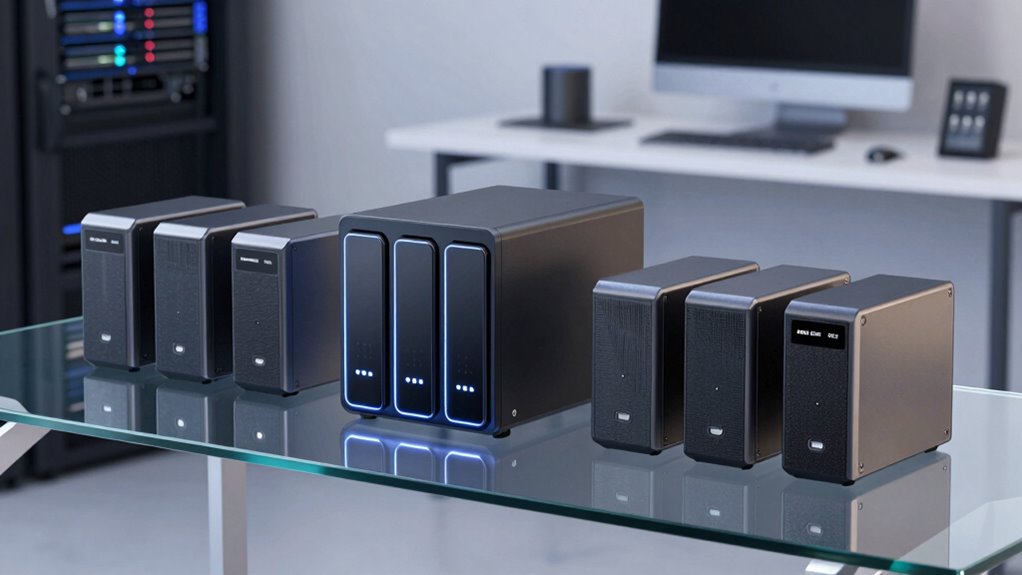
When choosing a network attached backup device, you’re looking for a reliable way to safeguard your data across multiple devices. The best picks balance performance, ease of use, and expandability, but you often face tradeoffs between cost and features. The ACEMAGIC NAS N3A stands out for its powerful hardware and flexibility, while the WD My Cloud offers a simple setup for personal use. For those on a budget, smaller options like the BUFFALO LinkStation 210 deliver basic backup capabilities. Continue reading for a detailed breakdown of these options and how to choose the right device for your needs.
Key Takeaways
- High-capacity NAS devices like the ACEMAGIC NAS N3A provide extensive expandability but come with higher complexity and cost.
- Simpler, single-bay options like the WD My Cloud are perfect for personal or light use but lack scalability.
- Pre-installed drives simplify setup, but diskless models offer more customization at the expense of initial setup time.
- Network speed, especially 2.5G Ethernet, is crucial for fast backups and restores, making hardware specs a key factor.
- Ease of use and management interfaces vary significantly—more advanced options offer greater control but require more technical knowledge.


More Details on Our Top Picks
ACEMAGIC NAS N3A 4-Bay Desktop Network Attached Storage Home & Office Backup Hub, Up to 136TB, 4×HDD + 2×M.2 Slots, Dual 2.5G + 1G LAN, 8GB DDR4, 128GB PCIe3.0 SSD, Diskless
The ACEMAGIC NAS N3A stands out for its impressive capacity potential, supporting up to 136TB with flexible drive options, making it ideal for users needing extensive storage for media, backups, or server functions. Unlike the simpler WD My Cloud, this model offers dual 2.5G LAN ports that ensure faster, more reliable data transfer, especially in busy networks. Its diskless design allows for tailored configurations, but that also means initial setup demands some technical knowledge and additional investment in drives. Compared to the BUFFALO LinkStation 210 6TB, the N3A’s expandability and speed make it more suitable for demanding environments, though it requires more technical skill and cost upfront.
Pros:- Supports massive storage up to 136TB with flexible drive choices
- Dual 2.5G LAN ports for high-speed, reliable networking
- Compatible with various OS and custom configurations
- Multiple connectivity options including HDMI and USB
Cons:- HDDs and SSDs sold separately, increasing initial cost
- Requires technical knowledge for setup and optimization
- No included drives, which can delay deployment
Best for: Tech-savvy home users or small offices needing high capacity, fast transfer speeds, and custom setups
Not ideal for: Beginners seeking plug-and-play simplicity or users with limited technical skills
- Maximum Storage Capacity:136TB
- HDD Bays:4
- M.2 Slots:2
- Ethernet Ports:2 (2.5G + 1G)
- RAM:8GB DDR4
- SSD:128GB PCIe3.0
- Connectivity:HDMI 2.0, DP 1.4, USB-A, USB3.2 Gen2 Type-C, 3.5mm audio jack
- Diskless:Yes
Our verdict“This device suits advanced users who want maximum storage flexibility and high-speed connectivity for demanding applications.”
WD 2TB My Cloud Personal Network Attached Storage – NAS
The WD My Cloud 2TB serves as a straightforward, user-friendly NAS solution perfect for families or small households looking for reliable centralized storage. Compared with the more advanced ACEMAGIC N3A, it offers a much simpler setup process and seamless mobile app integration, but it’s limited to 2TB of capacity, which may not suffice for larger media libraries or extensive backups. Its plug-and-play nature makes it ideal for non-technical users, but it lacks the speed and expandability of higher-end models, making it less suited for intensive data tasks or future growth.
Pros:- Very easy to set up and operate for beginners
- Supports remote access and automatic backups across multiple devices
- Works with Windows and Mac OS with minimal configuration
Cons:- Limited to 2TB, which might fill quickly for large media collections
- Requires internet connection and router support for remote access
- Lacks advanced features or expandability
Best for: Home users or small families needing easy access and automatic backups without complex setup
Not ideal for: Power users or small offices requiring large capacity or high-speed data transfer
- Storage Capacity:2TB
- Model:WDBCTL0020HWT-NESN
- Color:White
- Operating System Compatibility:Windows 10, Windows 8, Windows 7, Mac OS X
- Features:Remote access, PC and Mac backup, photo/video backup
- Support:DLNA/UPnP
Our verdict“This NAS makes sense for users seeking hassle-free, reliable storage for everyday home use and small backups.”
BUFFALO LinkStation 210 6TB 1-Bay NAS Network Attached Storage with HDD Included
The BUFFALO LinkStation 210 6TB offers a practical solution for users who want a ready-to-use, single-drive NAS for home backup and file sharing. Its included HDD simplifies setup, and with support for both Windows and macOS, it provides a straightforward way to centralize data. Compared to the 2TB BUFFALO LinkStation 210, this model doubles the storage capacity, making it suitable for users with larger media libraries or backups. However, its single-bay design limits future expandability and advanced features, meaning it’s best for basic needs rather than complex or growing storage requirements.
Pros:- Includes a 6TB hard drive for immediate use
- Simple setup for home network storage and backups
- Supports secure file sharing with access controls
- Two-year warranty and US-based support
Cons:- Limited to a single drive bay, restricting future expansion
- Basic feature set compared to higher-end NAS devices
- No support for RAID or advanced data management
Best for: Home users needing an easy, reliable, and larger capacity storage solution with minimal setup
Not ideal for: Power users or small offices looking for expandable or multi-drive solutions
- Capacity:6TB
- Number of Bays:1
- HDD Included:Yes
- Compatibility:Windows, macOS
- Support:24/7 US support
- Warranty:2 years
Our verdict“Ideal for users who want a straightforward, larger-capacity NAS without complexity or expansion needs.”
BUFFALO LinkStation 210 2TB 1-Bay NAS Network Attached Storage with HDD Included
The BUFFALO LinkStation 210 2TB provides a reliable, entry-level NAS option for personal or small household use. Its included HDD and simple setup make it accessible for users who want basic centralized storage and backups. Compared with the WD My Cloud, it offers similar ease of use but with the added benefit of a hard drive included right out of the box. Still, its capacity is limited, and it doesn’t support advanced features or future scalability, making it less suitable for larger media collections or users planning to grow their data needs.
Pros:- Simple to set up and operate
- Includes a 2TB hard drive for immediate use
- Supports secure file sharing and access restrictions
- Two-year warranty with US support
Cons:- Limited to 2TB, not suitable for large media needs
- Basic feature set without expandability
- Older support for macOS versions may limit some features
Best for: Individuals or families needing an easy, low-cost backup and storage device for small data loads
Not ideal for: Users with extensive media libraries or those needing more advanced management features
- Capacity:2TB
- Number of Bays:1
- HDD Included:Yes
- Compatibility:Windows, macOS
- Warranty:2 years
- Support:24/7 US support
Our verdict“This NAS is well-suited for basic personal storage and backups in small households or for beginners.”
UGREEN NAS DH2300 2-Bay Personal Storage for Beginners and Home Use
The UGREEN NAS DH2300 is tailored for those new to NAS devices, offering an intuitive setup, RAID options, and AI-powered photo organization. Compared with the simpler WD My Cloud, the UGREEN provides more security features and supports multiple OS platforms, including iOS and Android, making it a versatile choice for personal use. Its minimal power consumption and layered security make it appealing for environmentally conscious users, but its lack of Wi-Fi support and limited scalability mean it’s best suited for basic, home-centric storage needs rather than growing or enterprise environments.
Pros:- Easy to set up with layered security features
- Supports automatic backups and AI photo organization
- Compatible across multiple OS platforms
- Low power consumption for eco-friendly operation
Cons:- No built-in Wi-Fi, external USB adapter needed
- Limited to personal, non-enterprise use
- Does not support Docker or virtualization
Best for: Beginners and home users wanting secure, AI-enhanced personal storage with easy management
Not ideal for: Power users or those needing wireless connectivity or enterprise features
- Processor:High-performance
- RAM:4GB
- Network:1GbE, Wi-Fi via external USB
- Storage Capacity:Supports up to 64TB
- Security:RAID, two-factor authentication
- Compatibility:Windows, iOS, Android, macOS
Our verdict“This model fits users seeking straightforward, secure, and AI-enhanced storage for personal or home use without complexity.”
Zero1 2-Bay Desktop NAS, Beginner-Ready Silent Home Storage with 2.5GbE, 60TB Capacity (Diskless), Support Docker, Remote Access, 4K HDMI
The Zero1 2-Bay Desktop NAS stands out as an accessible entry point for those new to network attached storage. Its straightforward setup, combined with fast 2.5GbE connectivity, makes it ideal for personal backups and media streaming. Unlike the Synology DS124, which offers advanced security features and AI surveillance, Zero1 focuses on simplicity and quiet operation, though it sacrifices expandability and includes no drives. This model is perfect for users who want a hassle-free device that can handle remote access and Docker support without the complexity of larger systems. Tradeoffs include the need to buy drives separately and limited scalability due to only two bays, which may not suit growing storage needs.
Pros:- Easy setup and user-friendly interface
- Fast data transfer with 2.5GbE support
- Supports remote access and Docker for flexibility
- Compact and silent operation
Cons:- Requires separate purchase of hard drives
- Limited to two bays, restricting future expansion
Best for: Beginners seeking an easy-to-manage, quiet home storage solution with media capabilities
Not ideal for: Power users requiring extensive scalability or pre-installed drives for immediate use
- Capacity:Up to 60TB (diskless, drives sold separately)
- Connectivity:2.5GbE
- RAM:4GB
- Support:Docker, Remote Access, 4K HDMI
- Weight:2 kg
Our verdict“This pick is ideal for beginners who want straightforward, reliable home storage with multimedia support.”
BUFFALO LinkStation 210 4TB 1-Bay NAS Network Attached Storage with HDD Included
The BUFFALO LinkStation 210 4TB offers a straightforward, all-in-one storage package suitable for basic home backups. Its inclusion of a 4TB hard drive means users can start backing up right out of the box, unlike the Synology DS225+, which requires purchasing drives separately. However, with only one bay, expandability is limited, and it lacks advanced features like RAID or multimedia transcoding. This device makes sense for users who want a reliable, low-maintenance backup device without the need for complex configurations, but it’s less suitable for those who anticipate future storage growth or advanced media needs.
Pros:- Includes a 4TB hard drive for immediate use
- Simple setup process
- Reliable, dedicated backup solution
- Supports secure file sharing
Cons:- Limited to a single drive bay, restricting scalability
- Basic feature set compared to higher-end models
Best for: Home users needing an easy, ready-to-use backup device with minimal fuss
Not ideal for: Tech-savvy users or small offices looking for scalable or feature-rich storage
- Capacity:4TB
- Drive Bays:1
- HDD Included:Yes
- Compatibility:Windows, macOS
- Support:24/7 US-based support
- Warranty:2 years
Our verdict“This device suits users wanting a plug-and-play backup solution without future expansion plans.”
BUFFALO LinkStation 220 4TB 2-Bay NAS Network Attached Storage with Hard Drives Included
The BUFFALO LinkStation 220 offers a balanced mix of capacity, security, and ease of use for small teams or households. Its two bays support RAID 1 for redundancy, providing greater data security compared to the single-bay LinkStation 210. While the default RAID 1 halves usable capacity to 2TB, it protects data against drive failure, a key advantage for those with valuable files. Compared to the Synology DS225+, which offers hardware transcoding and more advanced features, the LinkStation 220 emphasizes straightforward backup and file sharing. The tradeoff is a somewhat limited feature set and capacity constrained by RAID configuration, making it suitable for secure backups rather than media-intensive use.
Pros:- Includes hard drives ready for setup
- Supports RAID 1 for data redundancy
- Easy to configure and manage
- Reliable 24/7 US-based support
Cons:- Usable capacity is halved with RAID 1 (2TB effective)
- Limited advanced features
Best for: Small home offices or families needing reliable, protected storage for multiple devices
Not ideal for: Power users who want extensive media streaming or virtualization capabilities
- Storage Capacity:4TB
- Number of Bays:2
- RAID Support:Yes, RAID 1 (default)
- Compatibility:Windows, macOS
- Included Hard Drives:Yes
- Warranty:2 years
Our verdict“This NAS is best for those prioritizing data safety and simple shared storage over multimedia performance.”
Synology DS124 Personal Backup & File Hub – 1-Bay Diskless NAS
The Synology DS124 targets individuals seeking a secure, customizable backup hub with AI-powered security features. Its single bay means limited scalability but excels in automatic backups, remote access, and integrated surveillance, making it more versatile than the BUFFALO LinkStation 210 for those who want a dedicated security component. Unlike the Zero1, which emphasizes multimedia, the DS124 emphasizes data protection and security, although setup may be more involved for users unfamiliar with Synology’s interface. This device is a solid choice for users prioritizing data ownership, security, and automation, but it requires an additional drive and some technical comfort.
Pros:- Automatic backups for multiple devices
- Secure remote access to files
- Built-in AI surveillance features
- Full data ownership with no subscription fees
Cons:- Requires additional hard drive to operate
- Limited to one bay, restricting storage growth
Best for: Tech-savvy individuals wanting secure, automated backups and surveillance in a compact form
Not ideal for: Beginners or those needing large or scalable storage out of the box
- Type:Diskless NAS
- Number of Bays:1
- Warranty:2 years
- Features:Backup, file sharing, home security, AI surveillance
Our verdict“This NAS is well-suited for users seeking secure backups and integrated security features in a compact device.”
Synology DS225+ Private Cloud Media Server – 2-Bay Diskless NAS with Intel CPU for Hardware Transcoding
The Synology DS225+ offers a compelling mix of media capabilities and data safety, making it the top choice for media enthusiasts. Its Intel CPU enables hardware transcoding for 4K streaming, surpassing the Zero1 in media performance. The dual bays support RAID setups for redundancy, providing peace of mind for data security. Compared to the BUFFALO LinkStation 220, which is more straightforward but less capable in media processing, the DS225+ caters to users with larger media libraries or surveillance needs, supporting up to 30 IP cameras. The tradeoff involves a more complex setup and the need to purchase drives separately, which can add to the cost.
Pros:- Supports 4K media streaming and hardware transcoding
- RAID support for data redundancy
- Supports surveillance with AI features
- Fast transfer speeds up to 282 MB/s
Cons:- Requires separate purchase of drives
- More complex setup for beginners
Best for: Media lovers and small home offices needing robust media streaming and data safety
Not ideal for: Beginners or those with minimal media and backup needs who prefer plug-and-play solutions
- Storage Bays:2
- CPU:Intel
- Transfer Speed:282 MB/s
- Surveillance Support:Up to 30 IP cameras
- Warranty:3 years
Our verdict“This NAS suits users demanding high-quality media streaming and comprehensive data protection with advanced features.”
Synology BeeStation 4TB Personal Cloud Storage Device
The Synology BeeStation 4TB stands out for its ease of setup and multi-device accessibility, making it ideal for individuals or small households wanting straightforward cloud storage. Unlike larger NAS units like the BUFFALO LinkStation 220, it offers a simplified, app-based experience, but its limited 4TB capacity may fall short for users with extensive data needs. It supports cloud backups from popular services, which is a plus, yet it lacks advanced security features—something more robustly offered by higher-end options. The reliance on a network connection for remote access can also be a bottleneck for users seeking always-on access without internet dependency.
Pros:- Easy setup with QR code scanning simplifies initial configuration
- Accessible from multiple devices and locations enhances flexibility
- Supports cloud backups from Google Drive, OneDrive, Dropbox
Cons:- Limited to 4TB storage capacity, restricting data volume
- Lacks advanced security features for sensitive data
- Requires consistent network connection for remote access
Best for: Individuals or small families seeking easy-to-use personal cloud storage with simple remote access.
Not ideal for: Power users or those with large data collections who need more than 4TB or advanced security.
- Storage Capacity:4TB
- Device Type:Personal Cloud Storage
- Connectivity:Web, Desktop, Mobile
- Features:File sharing, File editing, Cross-device sync, Cloud backup
Our verdict“This device fits casual users valuing simplicity and cloud integration over large storage or security features.”
BUFFALO LinkStation 220 12TB 2-Bay NAS Network Attached Storage with Hard Drives Included
The BUFFALO LinkStation 220 offers a substantial 12TB capacity with included hard drives and RAID support, making it well-suited for households that want a reliable, centralized storage hub. Compared to the UGREEN NAS DXP2800, which is more advanced and customizable but requires additional drives, the LinkStation 220 provides an all-in-one solution with easy setup and plug-and-play drives. However, it doesn’t support remote access or cloud integration, limiting its flexibility for users needing outside access. Its RAID support enhances data protection, but the reduction of usable capacity in RAID 1 (to 6TB) might be a compromise for those needing maximum space.
Pros:- Easy setup makes it accessible for non-technical users
- Supports RAID for enhanced data security and redundancy
- Includes hard drives, reducing initial purchase complexity
Cons:- Limited to macOS 15 and earlier for some features, reducing future compatibility
- RAID 1 halves the usable capacity to 6TB, which might be insufficient for some
- No remote access or cloud support limits outside connectivity
Best for: Home users seeking a straightforward, reliable NAS with built-in drives and data redundancy.
Not ideal for: Tech-savvy users wanting remote access, multimedia streaming, or cloud features, which this model lacks.
- Capacity:12TB
- Number of Bays:2
- RAID Support:Yes (RAID 0 and RAID 1)
- Supported OS:Windows, macOS
- Warranty:2 years
- Support:24/7 US-based
Our verdict“Ideal for users wanting a simple, dependable NAS with ample storage and redundancy, but not for those needing remote or cloud access.”
UGREEN NAS DXP2800 2-Bay Desktop NAS Network Attached Storage (Diskless)
The UGREEN NAS DXP2800 caters to more tech-savvy users and remote workers, offering impressive hardware like an Intel N100 quad-core CPU, 8GB DDR5 RAM, and 2.5GbE networking—features that support demanding tasks and multimedia. Its support for M.2 NVMe drives provides flexible storage scalability, unlike the self-contained drives in the BUFFALO model. The inclusion of 4K HDMI output adds multimedia versatility. However, being diskless means additional costs for drives, and its complexity might overwhelm casual users. This pick is perfect for those comfortable with hardware upgrades and seeking a high-performance, customizable NAS for both storage and media applications.
Pros:- User-friendly interface suitable for non-technical users
- High-speed 2.5GbE network connectivity supports fast data transfers
- Supports multiple M.2 NVMe drives for flexible, expandable storage
- Includes 4K HDMI output for multimedia use
Cons:- Requires purchasing and installing drives separately, increasing initial cost
- More complex setup and maintenance compared to ready-to-go NAS units
- Advanced features may be unnecessary for basic storage needs
Best for: Advanced home users, remote workers, or small offices needing high-speed, flexible storage and multimedia features.
Not ideal for: Beginners or users seeking a simple plug-and-play solution without the need for additional drives or technical setup.
- CPU:Intel N100 Quad-Core
- RAM:8GB DDR5
- Network Speed:2.5GbE
- Drive Bays:2X M.2 NVMe
- Video Output:4K HDMI
- Form Factor:Desktop NAS
- Diskless:Yes
Our verdict“Designed for users comfortable with hardware and seeking a high-performance, multimedia-capable NAS, but not suited for those preferring simplicity.”

How We Picked
To evaluate these network attached backup devices, I focused on practical factors that matter to typical buyers: performance capabilities, ease of setup and management, build quality, expandability, and overall value. Devices were ranked based on their hardware specs, connectivity options, and user interface design, ensuring they suit different levels of technical expertise. Cost was also a consideration, alongside features like remote access, RAID support, and pre-installed drives. This approach helps to identify which models are best for beginners, small offices, and power users alike, making the list both diverse and relevant.Factors to Consider When Choosing Network Attached Backup Device
Choosing the right network attached backup device requires balancing several key factors. Beyond just storage capacity, consider how easy the device is to set up and manage, especially if you lack extensive technical skills. Network speed and connectivity options influence how quickly backups and restores happen, which matters in busy environments. Expandability is useful if your storage needs grow, but it can also mean higher initial costs. Reliability and build quality ensure your data stays safe over time. Understanding these broader considerations can help you avoid common pitfalls, like underestimating future storage needs or buying a device incompatible with your network setup.
Performance and Connectivity
Fast data transfer speeds, such as 2.5G or 10G Ethernet, can significantly reduce backup and restore times, especially with large files. Compatibility with your existing network setup is essential; a device with multiple LAN ports or link aggregation can improve throughput. Consider whether the device supports the latest network standards, which future-proofs your investment and enhances overall reliability. Cheaper models might rely on slower connections, leading to frustration during backups or media streaming. Think about your typical data size and network environment to match the device’s performance capabilities accordingly.
Ease of Use and Management
Intuitive interfaces and straightforward setup processes make managing backups less stressful, especially for non-technical users. Many devices offer mobile apps or web interfaces for remote access, which can be a game-changer for convenience. More advanced options may provide features like RAID configuration, user permissions, and automated scheduling, but these can be overwhelming for beginners. Balance your comfort level with complexity against your need for control. Overly complicated systems might offer more features but can lead to setup errors or maintenance headaches.
Expandability and Future-Proofing
Devices with multiple bays or drive slots allow you to increase storage as your needs grow, avoiding costly replacements. Diskless models offer flexibility since you can choose your own drives, but they require additional setup effort. Consider whether the device supports hardware upgrades like adding RAM or network cards for future performance boosts. Be mindful that more expandable devices often come with higher price tags, so weigh your current needs against potential future requirements. If your backup needs are expected to grow quickly, investing in a scalable system makes sense.
Build Quality and Reliability
Since these devices store valuable data, durability and reliable hardware are paramount. Look for models with solid enclosures, good ventilation, and a reputable brand reputation. Devices with a history of firmware updates and active support tend to stay more secure and functional over time. Cheaper, off-brand options might save money upfront but can suffer from hardware failures or poor performance. Reliability also extends to software—robust backup and recovery features prevent data loss during failures or disasters.
Cost and Value
Prices can vary widely, from budget-friendly single-bay models to high-end, feature-rich NAS units. While it might be tempting to go for the cheapest option, consider the long-term value—more expensive models often deliver better performance, expandability, and support. Look for devices that include necessary features like pre-installed drives if you want quick setup, but also be aware of hidden costs like additional drives or licensing fees. Matching your budget to your actual needs helps avoid overspending on unnecessary features or underinvesting in critical capabilities.
Frequently Asked Questions
Can I use a network attached backup device for both personal and professional data?
Yes, many network attached backup devices are versatile enough to handle both personal and business data. For personal use, simpler models with basic backup features suffice, offering easy setup and management. For professional environments, look for units with advanced features like RAID support, remote access, and higher scalability. It’s important to choose a device that aligns with your security needs, data volume, and management complexity. Ensuring your device supports regular firmware updates and has a reliable support system can prevent many common issues.
How important is network speed when choosing a NAS device?
Network speed plays a significant role in how effectively a NAS handles backups, restores, and media streaming. Slower connections, like 1GbE, may suffice for small files or infrequent backups but can cause noticeable delays with larger data sets. Upgrading to 2.5G or higher speeds can dramatically cut down transfer times, especially in busy environments or when multiple users access the device simultaneously. Consider your current network infrastructure and future needs—investing in faster connectivity can pay off in smoother, more efficient data management.
Should I buy a diskless NAS or one with pre-installed drives?
Choosing between diskless and pre-installed NAS units depends on your technical comfort and customization preferences. Diskless models offer flexibility, allowing you to select drives that match your capacity and performance needs, and often cost less upfront. However, setting up drives and configuring RAID or other features requires some technical knowledge. Devices with pre-installed drives are more straightforward—they provide immediate ready-to-use storage but limit customization options. Consider whether you prefer convenience or control when making this decision.
Is a higher number of drive bays always better?
More drive bays generally mean greater expandability and redundancy options, which can be advantageous for larger or growing storage needs. However, they also tend to increase the cost, size, and complexity of the device. For small-scale backups or personal use, a single or dual-bay device might be sufficient and more cost-effective. Larger, multi-bay units are better suited for small offices or users with significant data volumes who require fault tolerance and scalability. Always match the number of bays with your current and anticipated storage requirements.
How do I ensure my data stays safe on a NAS device?
Data safety on a NAS device depends on multiple factors: using RAID configurations to protect against drive failure, enabling regular firmware updates for security patches, and implementing strong access controls. Regular backups of your NAS to an external location or cloud service provide an extra layer of security. Additionally, choosing a device with good build quality and active support minimizes hardware risks. Always keep your device’s firmware and software up-to-date to ensure you have the latest security enhancements and bug fixes.