
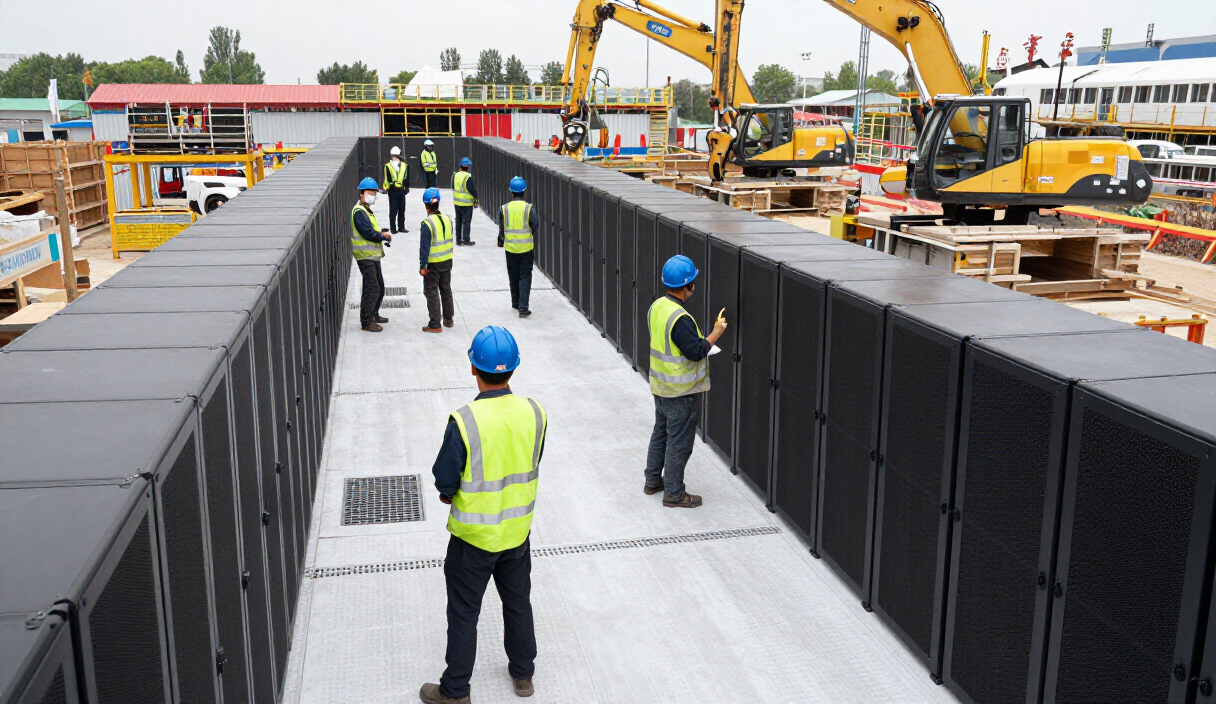
Data-centre construction concentrates the industry’s hardest coordination problems on one site. Many trades work in parallel, deadlines leave little room for delay, and decisions made in meetings must become trade-sorted task lists immediately. Field teams, plans, models, reports and third parties all need to stay connected while the project keeps moving.
Cloud & Hosting · Data-centre construction
The coordination gap sits between the meeting and the live site.
Many trades work in parallel under tight deadlines. Gewerkton Cloud is designed as the connective layer that turns site evidence, plans, models and meeting decisions into coordinated operational data.
Meeting output
Decisions and general notes
Operational requirement
Trade-sorted tasks that re-enter the project flow immediately
One branded house, three defined jobs
Cloud is not a separate archive: it connects where information is captured, developed and acted upon.
27
content languages
EU, US and APAC teams can work on one project in their own languages while the original evidence remains unambiguous. Chinese, Korean and Vietnamese crews are explicitly included.
13
AI providers in the BYO-AI model
Users bring their own keys and select the provider region to avoid vendor lock-in.
Data residency is a project choice
Hosting can follow project and jurisdiction requirements instead of a single global default.
Evaluation status
Public beta: fall 2026Infrastructure teams are evaluating a developing platform—not a finished, generally available product.
That is the operating context for Gewerkton Cloud. It coordinates operations and model data between the Gewerkton Field app, the Gewerkton Studio browser workspace and third parties. The aim is not to add another isolated tool to the project. It is to connect what happens on site with the workspace where plans and models are handled, then carry that information into the wider project environment.
Gewerkton is a voice-first construction documentation and defect management platform for global markets. It was born in the German market and has its deepest commercial integration there, including GAEB, REB, XRechnung and DATEV. Its broader design reflects the reality of international construction: 27 content languages, a choice of regional AI providers and support for projects spanning the EU, the US and Asia, including mainland China.
The product is in beta now. A public beta is planned for fall 2026. That status matters: infrastructure teams evaluating it are looking at a developing platform, not a finished, generally available product.
construction project management software
As an affiliate, we earn on qualifying purchases.
As an affiliate, we earn on qualifying purchases.
The meeting is only the start of the work
On a data-centre or industrial-plant project, the value of a coordination meeting depends on what happens immediately afterwards. A decision that remains in general notes is not yet an operational instruction. It has to be converted into work that can be understood by the relevant trade, connected to the project information and followed from the field.
The difficulty grows because multiple trades are active at the same time. Decisions do not move through a quiet, linear process. They enter a live site where different teams need different parts of the outcome. Tight deadlines make the gap between discussion and execution especially important. The useful result is therefore not simply a transcript or a meeting record. It is a set of trade-sorted tasks that can re-enter the project’s working flow without delay.
Gewerkton Cloud carries this part of the story because its role is operational coordination. Field captures what is happening on site. Studio provides the browser workspace for plans and models. Cloud coordinates the operations and model data moving between those environments and third parties.
That division gives each product line a defined job while keeping them under one brand. Gewerkton is a branded house with three product lines—Field, Studio and Cloud—not a collection of unrelated tools.
field data collection devices for construction
As an affiliate, we earn on qualifying purchases.
As an affiliate, we earn on qualifying purchases.
Field evidence has to survive the handover into coordination
The process begins with the people closest to the work. Gewerkton Field is the voice-first construction-site app. It turns dictation into evidence, defects, daywork reports, takt information and portal content. The emphasis on voice reflects a basic condition of site work: documentation has to begin where the activity takes place.
For data-centre teams, capture alone is not enough. Information from the field must remain useful when it reaches people working with plans, models and external project systems. Otherwise, the organisation gains another record but not better coordination. Cloud links Field with Studio and third parties so that site information belongs to a wider operating context.
This is also where Gewerkton’s marketing line earns its place: “On site, what counts is what’s proven.” A dictated observation can become evidence rather than disappearing into memory or being reduced to an informal recollection later. The platform’s field role is built around turning capture into documentation that can continue through the project workflow.
The same principle applies outside data centres. In housing and building construction, the stated use cases include defects with a photo and deadline, dictated daywork reports and a signature on the device at handover. On infrastructure and tunnel projects, where durations are long and change orders are numerous, instructions can be backed by the original audio. The environments differ, but the requirement remains consistent: information captured in the field needs to retain a clear relationship to its source.
cloud-based construction coordination tools
As an affiliate, we earn on qualifying purchases.
As an affiliate, we earn on qualifying purchases.
The browser workspace is part of the site workflow
Gewerkton Studio is the browser workspace for plans and models. Where no model exists, the site team can create one in the browser. That detail is important because a model cannot be treated as a universal precondition. Some teams will arrive with an established model; others will need to create the working representation as the project develops.
Studio therefore covers both conditions without changing the broader product structure. Plans and existing models have a browser workspace, while a team without a model is not excluded from model-based coordination. Cloud then sits between that workspace, Field and third parties, coordinating the operational and model data that pass among them.
For infrastructure professionals, this is the relevant distinction: the browser workspace and the coordination layer are related, but they are not the same thing. Studio is where plans and models are handled. Cloud is responsible for operations and model/data coordination across the product lines and external participants. Field remains the voice-first site interface.

construction site defect reporting app
As an affiliate, we earn on qualifying purchases.
As an affiliate, we earn on qualifying purchases.
Cloud is the connective layer
A data-centre project does not become coordinated merely because every team has software. Coordination depends on information moving between the places where it is captured, developed and acted upon. Gewerkton Cloud is positioned around that movement.
Its role can be understood through three relationships:
- Field connects site dictation, evidence, defects, daywork reports, takt and portal activity to the wider platform.
- Studio supplies the browser workspace for plans and models, including browser-based model creation where no model exists.
- Third parties remain part of the coordination environment rather than sitting outside the Field-to-Studio flow.
This structure directly addresses the data-centre construction case described by Gewerkton: many trades operating in parallel, tight deadlines and meeting decisions that must become trade-sorted task lists. Cloud is not presented as a separate archive after the work. It is the product line responsible for coordinating operations and model data while Field and Studio serve their respective users.
Data residency is a project choice
Cloud coordination inevitably raises a deployment question: where should project data reside? Gewerkton’s answer is explicit. Customers can choose an EU cloud or their own infrastructure.
That choice is deliberate rather than an afterthought. It allows the deployment decision to follow the project’s requirements instead of forcing every project into one hosting arrangement. The same principle appears in Gewerkton’s approach to artificial intelligence. Its BYO-AI model supports 13 AI providers, lets users bring their own keys and makes the provider region selectable across the EU, the US and Asia, including mainland China.
The stated purpose is to avoid vendor lock-in. A project can choose a regional AI provider instead of being tied to one provider or one region. For teams working across jurisdictions, the combination of selectable AI regions and a choice between an EU cloud and their own infrastructure makes infrastructure selection part of the operating design.
Projects in Asia are an explicit deployment field. Chinese, Korean and Vietnamese crews can work in a multilingual process from capture to report, while data residency remains a choice. Cross-border teams in the EU, the US and APAC can participate in the same project in their own languages, with the evidence original remaining unambiguous.
Language is an operational requirement
Data-centre programmes can involve teams from several regions on the same project. Gewerkton supports 27 content languages across its platform. That is not simply a translated marketing layer. The stated cross-border use case is that EU, US and APAC teams work on one project in their own language while the original evidence remains unambiguous.
This matters across the complete route from site capture to report. For projects in Asia, the platform specifically covers Chinese, Korean and Vietnamese crews. The regional provider choice also includes Asian providers, including providers in mainland China. Language, AI-provider region and data residency are treated as connected project decisions rather than as a single global default.
Gewerkton’s own marketing site follows the same international scope with 27 languages. It also operates with zero trackers, no cookie banner and a fully egress-free architecture. Those choices do not describe the construction workflow itself, but they show that regional reach and infrastructure decisions extend to how the company presents the platform.
One platform across demanding site types
Data centres and industrial plants are the clearest fit for the Cloud-led coordination story, but the platform’s deployment fields show how the same three-part structure applies elsewhere.

Wind farms and renewables
Distributed sites, rotating crews and field acceptance place pressure on field capture and coordination. Gewerkton includes offline capture for dead zones, allowing the site workflow to cover locations where connectivity is unavailable.
Housing and building construction
The workflow includes defects documented with a photo and deadline, dictated daywork reports and signatures on the device at handover. Here, Field carries much of the visible site interaction while Cloud and Studio connect it to the broader information environment.
Infrastructure and tunnels
Long project durations and numerous change orders increase the importance of maintaining the relationship between an instruction and its original evidence. Gewerkton’s stated use case keeps instructions backed by the original audio.
Cross-border and Asian projects
Multilingual capture and reporting support teams working across regions or within linguistically mixed crews. Users can work in their own language, with the original evidence remaining unambiguous and data residency selected according to the project’s deployment choice.
A small builder with an agent-driven development model
Gewerkton is being built by a solo founder directing a fleet of coding agents using Codex and Claude. In one night, that fleet shipped 21 software packages. The packages were verified with negative controls and mutation tests.
That development model is unusual, but it should not obscure the present product status. Gewerkton remains in beta, with the public beta planned for fall 2026. The company also has a media bank containing more than 51 self-produced clips and posters, supporting the platform’s presentation across its multilingual marketing presence.
Why Cloud carries the data-centre story
Field is where voice becomes site documentation. Studio is where teams work with plans and models, or create a model in the browser when one does not exist. Cloud is where the operational and model/data relationships between Field, Studio and third parties are coordinated.
That makes Cloud the natural centre of the data-centre construction use case. The defining problem is not any single report, model or meeting. It is the need to turn parallel activity into coordinated work under tight deadlines. Meeting decisions need to become trade-sorted task lists, and field information must connect to the plans, models and outside participants that shape execution.
Gewerkton approaches that problem as one branded platform with three clearly separated product lines. Its global design includes 27 content languages, 13 bring-your-own-key AI providers, selectable EU, US and Asian regions, and deployment through an EU cloud or the customer’s own infrastructure.
For infrastructure teams assessing the beta, the proposition is direct: use Field for voice-first site capture, Studio for browser-based plan and model work, and Cloud for the operations and model/data coordination between them and third parties. In the compressed, multi-trade environment of a data-centre build, that connective role is the one that determines whether a meeting decision stays a note or becomes organised work.