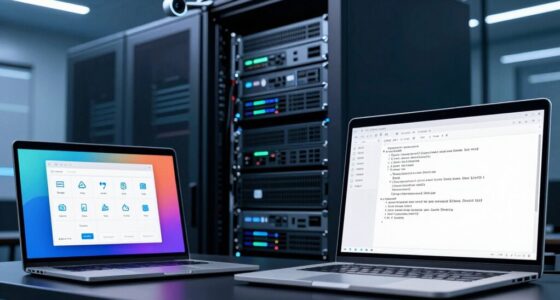

To decide if 40GbE networking is worth your upgrade, first evaluate your current latency, data transfer speeds, and whether they meet your needs. Check if your hardware supports 40GbE; outdated equipment may require costly upgrades. Consider your future growth plans—if your data demands are increasing, an upgrade can future-proof your network. We’ll explore how these factors can help you determine the right timing and approach for upgrading your network infrastructure.
Key Takeaways
- Assess current network latency and determine if 40GbE significantly improves performance for critical applications.
- Verify hardware compatibility to avoid costly upgrades or bottlenecks.
- Analyze cost versus benefits, considering existing performance and future scalability needs.
- Consider anticipated data growth to justify early investment for long-term infrastructure stability.
- Evaluate operational impact, including potential downtime, during the upgrade process.

Upgrading your network can seem intimidating, but making the right decisions guarantees your infrastructure keeps pace with growing demands. When contemplating a move to 40GbE networking, you need to evaluate whether the benefits outweigh the costs and effort involved. One of the first factors to examine is network latency. If your current setup already delivers low latency for your applications, upgrading might not markedly improve performance. However, if you’re experiencing delays during data transfers or real-time processes, moving to 40GbE could reduce latency considerably. This upgrade can be especially valuable for high-frequency trading, video editing, or large-scale data analysis, where milliseconds matter.
Upgrading to 40GbE can significantly reduce latency for data transfer and real-time applications.
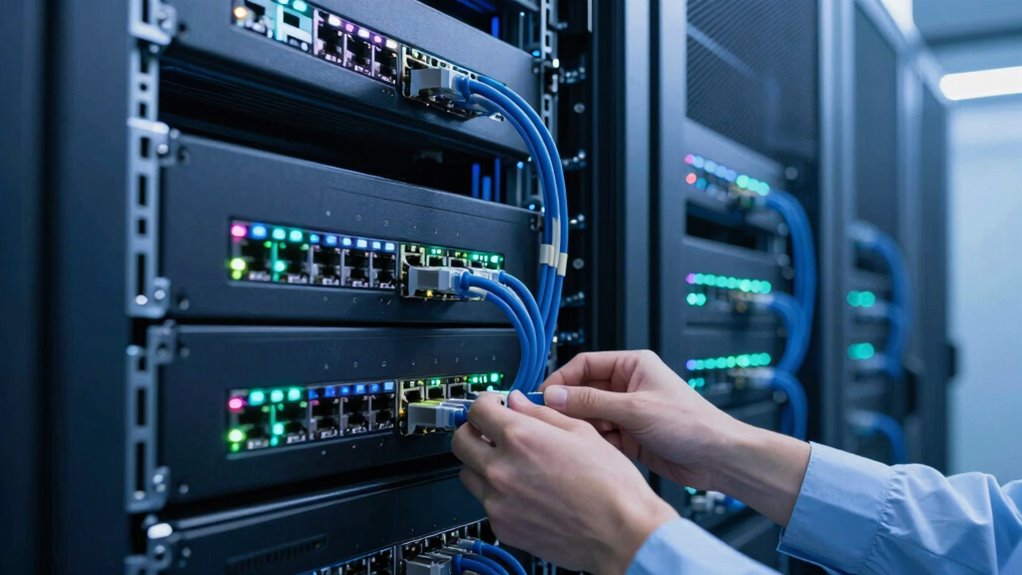
Another essential aspect is hardware compatibility. Not all existing equipment will support 40GbE, so you’ll have to assess whether your switches, routers, and network interface cards (NICs) are compatible with this higher speed. Upgrading to 40GbE isn’t just about plugging in new cables; it often requires replacing or upgrading multiple components to guarantee seamless operation. Compatibility issues can lead to bottlenecks or even system failures if overlooked. Consequently, you should review your current hardware’s specifications and consult with manufacturers to confirm compatibility. Sometimes, upgrading to 40GbE means investing in compatible hardware that might not be as cost-effective if your current infrastructure is outdated or limited.
Cost is another fundamental consideration. Transitioning to 40GbE involves hardware investments, potential downtime, and configuration efforts. If your network’s current performance adequately handles your workload, the expense might outweigh the benefits. Conversely, if you’re consistently pushing your existing network to its limits—causing slow data transfers, increased network congestion, or frequent bottlenecks—the investment could be justified. It’s also important to think about future network growth**; if you’re planning to expand your data center or increase data loads significantly, 40GbE might be a strategic move to future-proof your infrastructure. Additionally, understanding network bandwidth and its impact on overall system performance can help determine if the upgrade aligns with your operational needs. Being aware of network security implications is crucial, as higher speeds may require enhanced security measures to protect sensitive data during transmission. Moreover, assessing hardware upgrade costs** and timeline can help you plan accordingly to minimize disruptions during the transition.
Finally, consider your organization’s scalability requirements. If you anticipate rapid growth or increased data demands, upgrading sooner rather than later ensures you’re prepared. However, if your current network comfortably supports your operations, it’s wise to hold off until the need becomes urgent. It’s also advisable to assess the cost-benefit of such an upgrade thoroughly before proceeding. In brief, deciding when 40GbE networking is worth it hinges on evaluating network latency improvements, verifying hardware compatibility, analyzing cost versus benefit, and forecasting future growth. Making an informed decision helps you avoid unnecessary expenses while setting the stage for a robust, responsive network capable of supporting your evolving needs.
As an affiliate, we earn on qualifying purchases.
Frequently Asked Questions
How Does 40GBE Compare to 100GBE in Performance?
You’ll notice that 100GbE offers substantially higher bandwidth compared to 40GbE, enabling faster data transfer and better scalability. The bandwidth comparison shows 100GbE can handle more traffic, ideal for demanding applications. Latency differences are slight but important; 100GbE typically provides lower latency, resulting in quicker response times. If your network demands high throughput and minimal lag, upgrading to 100GbE makes sense, especially for data centers or large-scale operations.
What Are the Initial Costs of Upgrading to 40GBE?
Think of upgrading as planting a new seed; your initial costs are the soil and water. You’ll need a thorough cost analysis, considering equipment requirements like switches, network cards, and cabling. Expect higher expenses upfront compared to standard Ethernet, as 40GbE hardware is more specialized and costly. This investment promises faster data flow, but you should weigh the initial financial outlay against your long-term network needs.
Is 40GBE Compatible With Existing Network Infrastructure?
Yes, 40GbE is compatible with existing network infrastructure, but you’ll need to check fiber compatibility and hardware integration. Make certain your current switches and network cards support 40GbE or can be upgraded accordingly. Sometimes, legacy equipment may require additional modules or adapters. Carefully assess your fiber links and hardware capabilities to avoid bottlenecks, and consider future scalability to maximize your investment in 40GbE networking.
How Scalable Is 40GBE for Future Growth?
40GbE offers excellent scalability to support future growth, but bandwidth limitations can become noticeable as your data needs expand. Your existing hardware compatibility is vital; make sure your switches and network cards can handle 40GbE speeds. Upgrading now can future-proof your network, but you should evaluate whether your current infrastructure can support this bandwidth without bottlenecks. Planning for growth and hardware compatibility will help you maximize the benefits of 40GbE.
What Security Considerations Come With 40GBE Networking?
When implementing 40GbE networking, you need to take security carefully. You should use encryption protocols to protect data in transit from eavesdropping or tampering. Additionally, set up strict access controls to limit network access to authorized users and devices. Regularly update your security policies and monitor traffic for anomalies. These steps help guarantee your high-speed network remains secure against evolving threats.
As an affiliate, we earn on qualifying purchases.
Conclusion
Ultimately, upgrading to 40GbE networking isn’t just about catching up with the latest tech; it’s about understanding your specific needs. If your data loads are growing and latency is impacting performance, the upgrade makes sense. But if your current setup handles your workload smoothly, the theory that bigger is always better doesn’t hold true. Sometimes, sticking with what works is the smartest choice—until your demands truly outstrip your current network’s capabilities.
high-performance data center switches
As an affiliate, we earn on qualifying purchases.
As an affiliate, we earn on qualifying purchases.
As an affiliate, we earn on qualifying purchases.