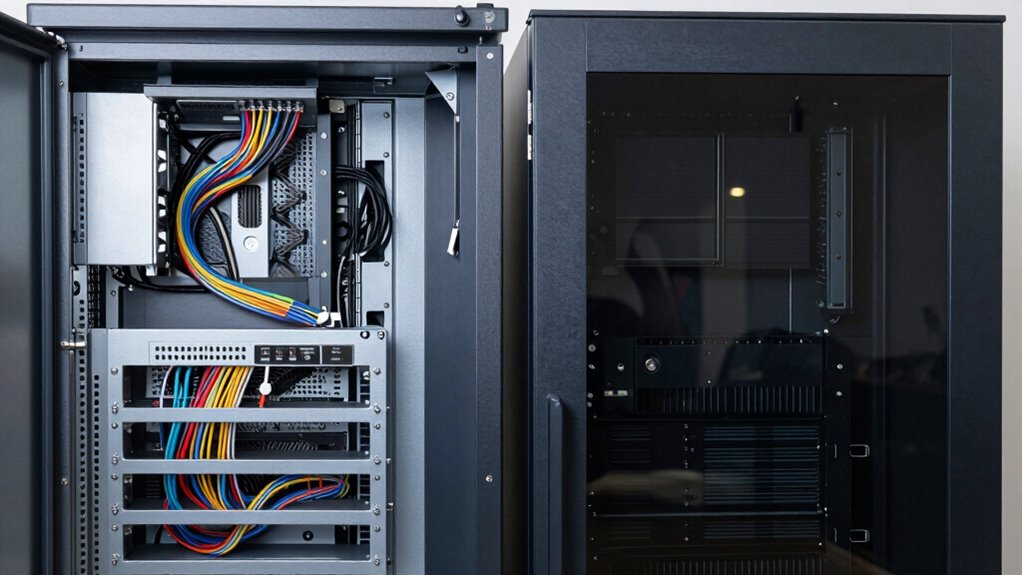

Choosing between open frame and enclosed rack cabinets isn’t as simple as it seems. Open frames offer better airflow and easier access, making them ideal for warm environments and quick upgrades. Enclosed cabinets provide security, environmental protection, and a neater appearance, but they tend to be pricier. Your decision depends on factors like security needs, cooling requirements, space, and budget. Keep exploring to uncover how these considerations can help you make the best choice for your setup.
Key Takeaways
- Open frame racks excel in cooling and airflow but offer less physical security compared to enclosed cabinets.
- Enclosed cabinets provide better protection against dust, debris, and tampering, suitable for sensitive or valuable equipment.
- Cost differences favor open racks initially, but enclosures may reduce long-term maintenance and security risks.
- Accessibility for maintenance is easier with open frames, while enclosures offer organized, clutter-free setups.
- Environment and future scalability influence the optimal choice, balancing cooling, security, space, and budget needs.
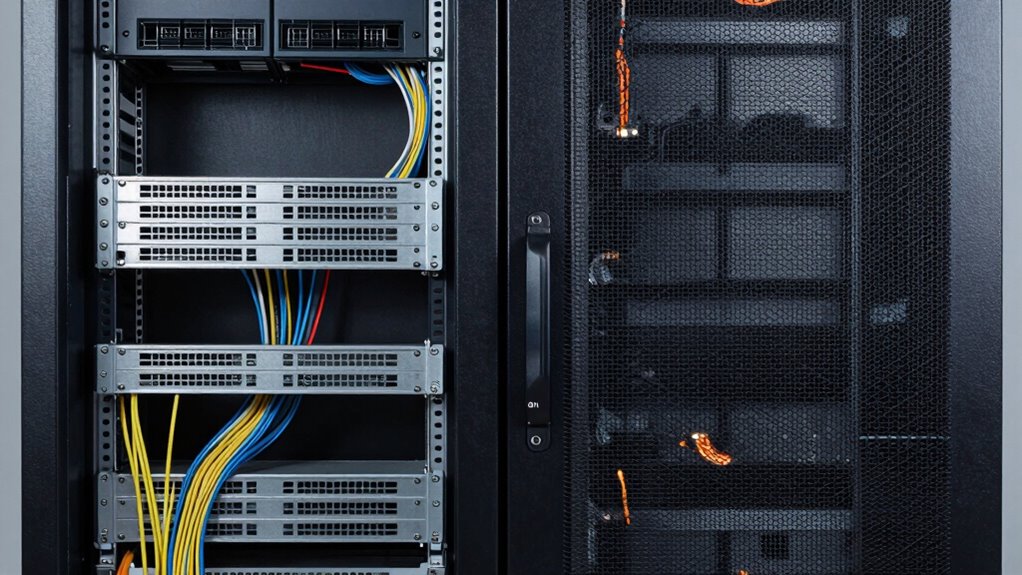
When choosing the right rack cabinet for your equipment, understanding the differences between open frame and enclosed designs is essential. While it might seem straightforward at first glance, the decision involves more than just aesthetics. Cooling efficiency plays a significant role; open frame racks tend to provide better airflow because they lack side panels, allowing heat to dissipate more effectively. If your equipment generates substantial heat or you operate in a warm environment, an open frame might be the better choice to prevent overheating. Enclosed cabinets, on the other hand, trap heat unless equipped with proper ventilation or cooling systems, which can sometimes add to the complexity and cost. Additionally, the design of enclosed cabinets can influence airflow management, impacting overall cooling performance. Security features are another critical factor that influences your decision. Enclosed rack cabinets typically offer more protection against physical tampering or accidental damage. They often come with lockable doors and panels, giving you peace of mind that sensitive equipment stays safe from unauthorized access. If you’re handling confidential data or valuable hardware, an enclosed design provides a higher level of security. Open frame racks are more exposed, making them less suitable if security is a top concern. However, they do allow easier access for maintenance and upgrades, which can be advantageous in environments where frequent servicing is needed. The physical environment where you plan to install your rack also impacts your choice. If space is limited or you need quick, straightforward access to hardware, open frame racks are typically more flexible. They are also easier to customize for specific needs, which can be a significant advantage in dynamic setups. Conversely, enclosed cabinets take up more space and require more planning but offer a cleaner, more organized look and better protection from dust, debris, and environmental hazards. Cost is another consideration. Open frame racks usually come at a lower initial price point because they have fewer materials and features. Enclosed cabinets tend to be more expensive due to their construction, security features, and added ventilation options. However, the investment in an enclosed cabinet might pay off by reducing downtime caused by overheating or equipment theft. Recognize that the choice between open frame and enclosed cabinets can also be influenced by installation environment, which should be carefully assessed. Properly evaluating the maintenance requirements of each option is crucial to ensure your setup remains efficient over time. Moreover, considering the future scalability of your rack setup can help you choose a design that accommodates growth without frequent replacements. Ultimately, your choice depends on balancing cooling efficiency, security needs, environmental conditions, and budget. Recognize that what seems like a simple decision can have broader implications for your equipment’s performance and safety. Carefully evaluate your specific requirements, and you’ll find that the difference between open frame and enclosed rack cabinets is more nuanced than it appears at first glance.

Tecmojo 12U Open Frame Network Rack for IT & AV Gear, AV Rack Floor Standing or Wall Mounted,with 2 PCS 1U Rack Shelves & Mounting Hardware,Network Rack for 19" Networking,Audio and Video Device
- Heavy-duty Steel Construction: Supports up to 260lbs on ground mount
- Open Frame Design: Provides ample space and ventilation
- Includes 2 Shelves & Hardware: Complete with mounting accessories and straps
As an affiliate, we earn on qualifying purchases.
As an affiliate, we earn on qualifying purchases.
Frequently Asked Questions
How Do Open Frame and Enclosed Racks Compare in Cost?
Open frame racks are generally more cost-effective upfront because they lack doors and panels, but they may increase fire safety concerns and reduce aesthetic appeal. Enclosed racks tend to be pricier due to their added security and better fire safety features, along with a sleeker look. If you prioritize aesthetic appeal and fire safety, the higher initial investment in enclosed racks might be justified, offering better long-term value.
Which Rack Type Offers Better Soundproofing?
Enclosed rack cabinets offer better soundproofing because they provide superior acoustic insulation and noise reduction. By enclosing your equipment, you minimize noise escape, making them ideal for environments where noise control is important. Open frame racks, on the other hand, lack this insulation, allowing sound to travel more freely. If soundproofing is your priority, selecting an enclosed cabinet guarantees a quieter workspace and better noise management.
Are Open Frame Racks Suitable for Outdoor Use?
Open frame racks aren’t ideal for outdoor use because they lack weather resistance, leaving equipment vulnerable to moisture and dust. You’ll also find they offer limited security features, making them easier for unauthorized access. If outdoor deployment is your goal, consider enclosed racks with weatherproofing and security enhancements to protect your gear effectively. Open frame racks are best suited for indoor environments where climate and security aren’t major concerns.
How Do Maintenance Requirements Differ Between the Two?
Imagine you’re managing a data center with open frame and enclosed racks; your maintenance focus shifts considerably. With open frames, you’ll spend more time on cable management, as cables are exposed and need regular organization. Enclosed racks offer better cooling efficiency, reducing thermal issues, but require less frequent cleaning. Overall, enclosed racks simplify maintenance, while open frames demand ongoing attention to cable layout and airflow management to prevent overheating.
Can Open Frame Racks Support High-Density Equipment?
Yes, open frame racks can support high-density equipment, but you need to take into account cable management and ventilation efficiency. Because open frame racks lack doors and sides, they allow for better airflow, which helps keep high-density gear cool. However, managing cables becomes essential to prevent clutter that could obstruct airflow. Proper cable management guarantees you maintain ideal ventilation and maximize the rack’s capacity for high-density equipment.

NavePoint 22U Server Cabinet Wall Mount Rack Enclosure with Caster Wheels, 2 Fans, Locking Glass Door, Removable Side Panels – 22U Network Cabinet 23.6” Deep, 19” Server Rack for A/V Equipment
- Durable Construction: Made from cold-rolled steel with powder coating
- Supports Up to 130 lbs: Sturdy housing for network and server equipment
- Versatile Installation: Wall-mount or free-standing setup options
As an affiliate, we earn on qualifying purchases.
As an affiliate, we earn on qualifying purchases.
Conclusion
While choosing between open frame and enclosed rack cabinets might seem straightforward at first, it’s really about finding the right fit for your needs. Sometimes, the open approach offers easy access and flexibility, but the enclosed option provides better protection and security. Ultimately, it’s about balancing your priorities and embracing the subtle differences that make each choice unique. Trust your instincts, and you’ll find the perfect solution that keeps everything running smoothly and seamlessly.

Tecmojo 6U Wall Mount Server Cabinet IT Network Rack Enclosure Lockable Door and Side Panels Black, Cooling Fan, Standard Glass Door, 450mm Depth, for 19” IT Equipment, A/V Devices
- Space-Saving Wall Mount Design: 6U cabinet with compact dimensions
- Secure Lockable Doors: Glass door and side panels for security
- Flexible Door Orientation: Reversible front door for swing preference
As an affiliate, we earn on qualifying purchases.
As an affiliate, we earn on qualifying purchases.
Tecmojo 6U Wall Mount Server Cabinet IT Network Rack Enclosure Lockable Door and Side Panels Black, Cooling Fan, Standard Glass Door, 450mm Depth, for 19” IT Equipment, A/V Devices
- Space-Saving Wall Mount Design: 6U cabinet with compact dimensions
- Secure Lockable Doors: Glass door and side panels for security
- Flexible Door Orientation: Reversible front door for swing preference
As an affiliate, we earn on qualifying purchases.
As an affiliate, we earn on qualifying purchases.